|
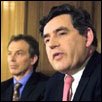
Blair and Brown unite on top-up fees
Tony Blair and Gordon Brown have united behind the government's plans to introduce university top-up fees.
But the strained relations between the prime minister and chancellor have again come under the media spotlight.
Ministers are facing a serious backbench rebellion by Labour MPs on the controversial policy, and it remains unclear whether there will be enough votes to ensure the bill's passage through the Commons.
The introduction of the legislation has been delayed until January while senior minister's seek to argue the case for reform of the existing system.
Speaking to Sky News on Sunday, the prime minister accepted that there were strong views on the issue.
"It is a huge argument to make and it is as big an argument as people made when they were founding the welfare state or the argument the Conservatives had in the 1980s," he said.
And the chancellor, who's support for the policy has also been called into question despite recently giving it his endorsement, predicted that the government would be able to push the legislation through parliament.
"Tony Blair will win this vote. We're going to win this vote and we are going to win the reforms," he told BBC1's Breakfast with Frost programme.
Brown said that the variable top-up fees policy was the correct way to fund the expansion of higher education.
"It is the system that will deliver most opportunity in this country," he said. "The variable fee is part of the scheme but the system of repayment is going to be fair and that is the key to this."
The government appears set to make some concessions on their plans in an attempt to win round potential rebels.
While the prime minister has made it clear that the central principle cannot be changed, he has not ruled out some changes in areas such as the threshold at which repayment of the fees should begin after graduation.
At present it is set at £15,000 a year, but there has been speculation that this could be raised to £18,000 or £20,000 a year.
"This is not die-in-a-ditch stuff about where we set the threshold," higher education minister Alan Johnson told ITV1's Jonathan Dimbleby programme.
"That is one of the issues that many backbenchers have said that they have concerns about. We need to address those concerns and think about the points they make."
But while the two most powerful men in the government were united in their support for the policy, there was also renewed questioning over the chancellor's ambition to take over the top job.
Asked if he still wished to be prime minister, Brown said: "I am not thinking about that at all. I am thinking about the job I'm doing."
And Blair said that his "partnership" with the chancellor would continue.
"Partnership implies that I am the prime minister and he is the chancellor," he said.
But he accepted that wishing to become prime minister was "not an ignoble ambition". "People are perfectly entitled to do that."
Blair went on to lavish praise on Brown's performance as chancellor since 1997.
"The British economy under Gordon has been probably the best run economy of any in the western world," said the prime minister.
"So the job he has done for Britain and for the British economy is fantastic and the partnership we have over these last 10 years in changing the Labour Party and in changing the country is a partnership that will endure.
"And it doesn't matter how many times people try to put rifts between us - it will not work."
|