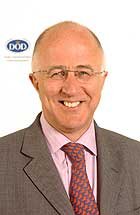
On Thursday 27 January 2005 I took part in one of the most extraordinary days of my life. Together with Prince Edward, the Foreign Secretary, Jack Straw, Lord Greville Janner and other prominent leaders of the Jewish community in Britain I travelled to Auschwitz in southern Poland.
60 years previous soldiers of the Red Army who had lost 600,000 men as they fought their way through Poland against the German Army arrived at the place of Europe’s greatest ever shame: Auschwitz.
On one of the coldest days of 2005 we landed in snow at Katowice – a mining town which I last saw in even colder weather on a December day 25 years ago. Then it was one of the centres of the trade union, Solidarity, which broke apart the communist control of Poland and signalled the beginning of the end of communist dictatorship in Europe.
Katowice and nearby Krakow are cities in the heart of central Europe. There have always been good roads and railways (now airports) and it seems that is why the Germans decided it was a place to build an extermination camp.
Hatred of the Other
At the core of Nazi ideology was hatred of Jews. The Nazis also hated Roma and Sinta people whom they despised as “gypsies”. They hated people of different races. They despised homosexuals and put into prison left-wing politicians, trade unionists, and priests who opposed Nazism. Many dictatorships imprison, repress, torture and even kill those they do not like. In the name of an ideology, an empire, and, alas of religion people have been persecuted.
But Hitler used the industrial and organizational abilities of the efficient, hard-working Germans and took the world over the brink into a new abyss of evil – the methodical, patient, hi-tech extermination of an entire people – the Jews of occupied Europe. Hitler believed in racial “purity.” The German word for the people the Nazis despised was ‘Untermenschsen’ – literally ‘subhumans’. Many have read the diaries of Anne Frank, the studious Dutch girl, who was Jewish and hid away in Amsterdam until a neighbour denounced her and she was deported as a Jew from her native Netherlands to die in one of the Nazi camps. She would have been an old lady – perhaps a granny today – but the politics of intolerance and race hate and the pleasure people can take from watching those of other religions and races be badly treated led to her death when she should have been studying for the Dutch equivalent of A/Ls.
The ‘Final Solution’ – the Death Camps
The Nazis decided that there had to be a “final solution” to their hatred of Jews by systematically seeking to kill all Jews in Europe under German control. In 1942, Auschwitz II Birkenau became the main extermination centre for the final solution to the Jewish question. Nazi officials and photographers recorded their actions. What happened was well documented. Jews were transported to Auschwitz-Birkenau in sealed trains from all over Nazi-occupied Europe In 1944 train tracks were extended right into the camp to speed up processing of prisoners. Those deemed unfit to work - up to 75% according to camp commander Rudolf Höss’s later testimony - were marched to what they were thought were shower rooms. The photos show mums and grannies hurrying children along. But they were not going to be showered with water but rather gassed with cyanide. 2000 people could be killed in 15-20 minutes. The bodies were shaved, gold teeth extracted, impaled on meat-hooks and conveyed to nearby incinerators – the crematoriums. The hair was processed to make shirts and blankets.
In January 1945 after the fall of Warsaw the Soviet Army pressed West across Poland. The Nazis retreated, dynamiting the extermination facilities. I saw the twisted rubble which is still there. 58,000 prisoners (mostly Jews) were sent out of the camp on "death marches" to camps in Germany. Most died en route. When Red Army soldiers entered Auschwitz on January 27 they found:
- 600 fresh corpses
- 7,650 skeletal prisoners
- 350,000 men’s suits
- 837,000 women’s garments
- eight tons of human hair packed for shipment..
Over one million sets of clothes for men and women. The Nazis hated Jewish women and children above all. Women are the future of any people, the carers, those who transmit knowledge and love. Within the genocide of the Jews there is also a “gendercide” – a pattern we have seen elsewhere in the world as men decide to kill women in order to stop the birth of new generations of a people.
It is now accepted that something over one million people were murdered at Auschwitz, about 90% Jewish. Tens of thousands of Russians, Roma, Poles and Western POWs also died, from murder or brutality or neglect. Auschwitz is Europe’s largest cemetery even if there are no grave stones.
Nazi not Polish Camps
Many Poles have mixed feelings about Auschwitz and other less well known Nazi death camps on today's Polish territory (Majdanek, Stutthof, Belzec, Cumhof, Sobibor and Treblinka where together many more Jews were murdered than at Auschwitz). Poland's former Communist regime kept the camps as far as possible intact as memorials to the anti-Fascist struggle.. Hence internationally the camps are sometimes wrongly known as "Polish” death camps. Quite rightly the Polish Foreign Minster Adam Rotfeld has denounced this misleading description. (The Israeli authorities respect Polish concerns, referring to "Nazi death-camps on occupied Polish territory"). Poles want due respect given to the massed Polish victims of the Nazis, some three million people.
There are other mass murdering regimes in the world. There are still left-over communists in Poland and elsewhere who find excuses for the crimes of Stalin, Lenin and Trotsky in Russia and neighbouring countries under the Soviet dictatorship in which millions died.
There are armies, even of democratic states, that use excessive force and can be guilty of crimes. But those crimes are exposed and denounced and those accused of such crimes are put on trial. The Nazi extermination of the Jews did not happen close to fighting or in connection with military action. It was based on nationalism and ideas of one nation and race being superior to another. It is unique in history. And although lessons must be learnt and the political genes that gave rise to Nazism are still lingering in the DNA of some politics today the Holocaust and a place like Auschwitz belong uniquely in its time.
A Moral and Historical Challenge
Auschwitz was 'only' one among many Nazi death camps, but it now symbolizes all of them. It is the planet's most morally challenging memorial complex, a monument to a meticulously implemented attempt by the parents and grandparents of millions of our fellow German Europeans to obliterate a complete people from the face of the earth. Its importance - and difficulties in managing the site and its memory - will be with us indefinitely.
I had never been in Auschwitz before though together with three of my children we have visited the extermination camp of Majdenek, just outside Lublin in eastern Poland. To see the crematoria, the slabs on which dead bodies had their gold fillings ripped out, and the flags of every nationality (including every European nation like Britain) who had been murdered by the Nazis in Majdenek was too much.
I can think of no greater duty than to transmit to generations until the end of time the enormity of the evil that happened at Auschwitz, Majdenek, Treblinka and the other places which the Nazis built just to murder people because they were the wrong religion.
Although on Polish soil, they are not part of Polishness. 6 million Poles were killed in World War 2 – half of them Jews, the other half mainly Polish catholics. One the bravest Poles, Father Maximilian Kolbe, sacrificed himself for a Jew in Auschwitz. He took the man’s place in a typhus ridden hut. The Jew survived. He was interviewed on Polish television on his 90th birthday. Father Kolbe died.
Poles Fought for Freedom
My father was Polish. He fought as a young army officer in the campaign when Hitler invaded Poland in September 1939. He took a German bullet in the shoulder and after returning to his village he escaped over the snow-covered mountains to Romania and then Hungary and then to rejoin the Polish army in France. After the collapse of the French army in June 1940, he was evacuated to Scotland, trained as a commando but an illness from his wound and privations had entered his kidneys and his fighting days were over. He married my mother from a Scottish-Irish family in Lanarkshire where I was born, had his three boys and died at the age of 42. I now carry my mother’s name but was plunged back into Poland when I worked to develop support in the West for the Solidarnosc trade union in the 1980s. I was arrested and briefly imprisoned by the communists in 1982. Two decades later I found myself as Britain’s Europe Minister welcoming Poland into the community of nations in the European Union.
There are many in Britain who do not like the EU but for Poles it is now the guarantee of their democratic independence as well as offering the hopes of economic growth that Europe has brought to nations like Ireland, Greece, Spain, Portugal that knew mainly poverty before the EU was created. It remains a puzzle to me why so many of my fellow citizens are hostile to Europe.
Britain’s Role in the 1930s
In the 1930s, many British politicians wanted nothing to do with Europe. The Conservative prime minister, Neville Chamberlain, referred to Czechoslovakia as “ a faraway country of which we know nothing.”
Papers like the Daily Mail supported Hitler and Lord Rothermere, a powerful newspaper owner, campaigned to stop asylum seekers from Nazi Germany – mainly Jews – from being allowed into Britain because of the argument used then that with a population a little over half of the British population today we were an over-crowded island.
In fact, Poland in the late 1930s accepted more Jews fleeing from Nazi persecution than did Britain. There was a great deal of anti-semitism in Poland, as elsewhere in Europe, but 150,000 Jewish soldiers fought in the Polish Army. I wonder if my father had any fellow officers who were Jews in 1939? Many Polish Jewish officers were amongst those killed on Stalin’s orders in Katyn when the Russian tyrant ordered the mass murder of 10,000 Polish army officers who had been arrested by the Russian Army when it invaded and occupied eastern Poland after the Nazi and the Communist rulers of Germany and Russia signed their infamous pact in August 1939 which gave the green light to World War 2..
History teaches us that men can do terrible, evil things to other men. Britain invented the concentration camp during the Boer War. The United States had a shameful record of killing native Americans as the white citizens advanced to occupy the land of native Americans in the 19th century. France’s history as a colonial power even after 1945 is marked by moments of mass slaughter and torture. Millions of Indians died in Bengal during World War 2 because the British rulers of India refused to help combat famine.
The Importance of Democracy
But in each and every one of these historical moments there were great cries of protest and changes in laws or government practice to stop such evil. That is the glory of democracy. Democratic governments do bad things but there are corrective forces. Under Hitler or Stalin or Pol Pot or Saddam Hussein the absence of democracy means that mass murder goes unchecked, torture goes unexposed, the capacity of men to torture, kill, exterminate their fellow human beings is made official policy.
Nothing in human history compares to what the Germans did at Auschwitz. At concentration camps in Germany like Buchenwald or Dachau or Belsen, people were brutalised, tortured, died of illness, exhaustion, or as the result of beastly medical experiments. But organised, industrial, assembly-line killing of one million people in the Nazi extermination camps in Poland is different from all other forms of brutality.
Such was the force of nation-first racist politics under Hitler and such was the need to find “the other” to destroy that one of Europe’s great nations turned itself into an extermination machine against fellow-Europeans.
Try and imagine a small railway station – maybe like Rotherham Central in my constituency. Only there is no platform or ticket office. Every few hours, a train arrives carrying thousands of people. They stumble out. On a long mound of earth, the guards stand to make sure no-one escapes. But there is nowhere to escape to.
At the historical ceremony on 27th January 2005, there were rows of chairs for the presidents, prime ministers, cardinals, ministers and other dignatories. We sat or stood shivering as the cold seeped through our warm modern winter clothes until you could not feel your feet and every part of your body was frozen solid. Think what it was like in January 1944 or January 1943 or 1942.
As the Jews came out of the train, the guards quickly took the able-bodied men to one side to work in the labour camp – they were amongst those who survived. If you were “lucky” off you went to work as a slave in one of the factories that German companies set up in the broader Auschwitz complex – the film “Schindler’s List” gives some idea of the economic activity. The book is worth reading too.
If you were a small Jewish child, or old, or a women with a baby you were told to get undressed quickly to have a shower to get rid of lice. Quickly they pushed you into a large empty concrete room – imagine a couple of tennis courts under a low ceiling.
The doors were slammed shut. And then the poison gas was unleashed. It took 20 minutes to kill everyone. Gold rings or good tooth filling were ripped off and then the bodies were moved to a crematorium to be burnt. The human body is full of fat. The German used it to make soap.
More than one million people were killed in this highly organised, industrial, planned manner. Germany’s best engineers, chemists, bricklayers, and railway workers all came together using their skills and developed European know-how to kill so many. In many other parts of Europe – France, the Netherlands, Lithuania, Croatia, and Hungary – the authorities collaborated with the Germans to send Jews or Roma to their death. In Britain we were never occupied. But read the hate language against asylum-seekers in the right-wing of the 1930s or read the account of how isolationist ministers sought to appease Hitler and ask yourself if there would not have been people in Britain who would have been willing to collaborate with the Nazis.
Walking on the dead
As I walked across Auschwitz I was walking on earth which contains more human remains than any other part of the world. None of the names of the people killed were recorded. There are no grave stones. Death is everywhere but this is not a cemetery as any of us know it. The landscape is flat. A few birch trees are covered by snow on their thin winter branches. The gas chambers and crematoria are one-storey buildings. The huts in the labour camp are single storey. The watch-towers are hardly higher than 4 metres. The electrified fence is no bigger than I am. The word Poland means “plain” in Polish and Auschwitz is on a plain, flat, open without relief.
We gather to think of what happened. The presidents of Poland and Russia speak. President Chirac of France sits immobile. Other presidents, prime ministers and national leaders huddle into the freezing seats trying to find warmth. Cardinal Lustiger, himself born a Jew, but now the head of the Catholic church in France reads out the Pope’s message. Simone Veil, the great French politician, herself an Auschwitz survivor, speaks with awesome clarity. I interpret her French for Flo Kaufmann, Vice President of the Board of Deputies of British Jews.
“What would have become of them,” asks Mme Veil, “of this million of Jewish children, murdered in their infancy here. Would they have become philosophers? Artists? Great scientists? Or perhaps just skilled craftsmen or mothers of families? All I know is that I keep crying whenever I think about them and that I will never forget them.”
A Pole, Wldyslaw Bartoszewksi, described how “It was an unimaginable emotion since back in September 1940 I first stood in Auschwitz in the crowd of 5,500 Polish students, Polish scouts, teachers, lawyers, doctors, priests, Polish army officers, activists from various political parties and trade unions. I never imagined I would outlive Hitler or survive World War 2. Likewise I did not expect that Auschwitz would become a scene of a unique plan of biological extermination of European Jews.”
As listened to this survivor of Auschwitz – old but steady and strong in voice, we realised that this was the last time the witness of Auschwitz would tell the story on such a solemn occasion. Mr Bartoszewksi describd how the Polish government-in-exile issued a statement in December 1942 calling on Britain and the other allies “to find means which will effectively prevent the Germans from perpetrating mass murder.”
We Should Have Done More
But by bit the news did get out about what was happening in Auschwitz and the other extermination policies of the Nazis. But we in Britain, the Americans and Russians refused to fly planes to try and bomb the transport links to Auschwitz. Sir Martin Gilbert, the great historian of the Holocaust, had described the inertia and the excuses found to do nothing despite the wish of the Prime Minister, Winston Churchill, that the RAF bomb the rail lines leading to Auschwitz.
Standing there looking at this narrow track, the difficulties of hitting it with bombs are obvious. But a series of attacks would have sent a clear message to the Nazis that their genocide was known to the world. The wartime Allies – Britain. America and Russia - has thousands of bombers nut none were used to hit Auschwitz to try and save Jewish lives.
Hand-wringing in the 1990s
It is not easy to decide what to do faced with evil that is beyond our imagination. Before 1997, I listened in the House of Commons to all the reasons why Britain could not intervene effectively in the western Balkans to stop the mass killings in Croatia and Bosnia. In 1995, 8,000 Europeans who happened to be of age-old Muslim faith were being taken away and murdered in cold blood by Serbs nation-first extremists. Those accused of those massacres, the Serbs, Mladic and Karadzic and a Croatian accused of terrible war crimes against Serbs, a man called Gotovina, are still free.
Brave MPs like Calum McDonald, and John Home Robertson and Sir Patrick Cormack spoke out in the Commons in the debates in early and middle 1990s calling for Britain and other European nations to take action. But we did too little and too late.
Today after all these cataclysmic events the Jewish population in Poland is a mere 15,000 people. These figures inch upwards as a steady trickle of Poles find out that they have Jewish blood, their parents or grandparents having abandoned their roots to try to save themselves. Jewish events are flourishing. Yet even with such tiny numbers of Jews Poland has sent the rise of 'anti-Semitism without Jews'. Extreme politicians of right and left readily resort to anti-Semitic tricks to attack political enemies as 'internationalists' or 'Polish-speaking' (i.e. not "pure" Polish). Polish patriotic demagogy too easily veers into dark talk of the threats to Poland from dark forces based in Moscow and Tel Aviv - and now Brussels. Anti-Semitic pamphlets which would be banned in the UK are available at kiosks in Warsaw. Anti-Semitic stickers and graffiti are often seen.
In Poland in 2003, I saw many posters of the country’s president, Alexsndr Kwasniewksi, which were spray-painted with the word “Zhid” – Yid, the ugly hate word used against Jews a bit like racists in Britain refer to “Pakis” or “Coons” for Asians or West Indians.
The long and largely successful history of the Jews in Poland came to an end under Hitler's fiendish supremacist ideology. After nearly two thousand years of theological rivalry a Polish Pope has helped reconcile Catholics and Jews by proclaiming that anti-Semitism is a sin.
Is There a Lesson from Auschwitz?
So what is the Lesson of Auschwitz? That millions of Jews and Poles were murdered by the Nazis? Or something deeper? In recent years the crime deemed inconceivable after the Holocaust - genocide - has happened again in Asia (Cambodia), in Europe (Srebrenica) and in Africa (Rwanda). On Thursday 27th January 2005 I was there with Auschwitz survivors and fellow representatives from all over the world to gather at Auschwitz-Birkenau on frozen soil mixed with the ashes of over one million Jewish, Polish, Roma and other victims to ponder the impenetrable evil of these events. Which is bigger - the spark of hope or the surrounding blackness?
All these thoughts and memories swirled through my head as I watched Prince Edward and Presidents Chirac and Putin place candles of memory on the ground where so many Jews were exterminated.
What is it in our minds that can lead to such hate of other peoples and religions? In the Commons two days before I had to listen to a tirade against France from a right-wing politician. He is decent, generous man but why use such language against a neighbour, partner and ally? In the 1930s, Britain was less generous than Poland in accepting Jewish asylum seekers. Today, the number of asylum seekers in our country has fallen by two-thirds. But still politicians try to make as much political capital as possible from this issue.
Anti-semitism and Islamaphobia – old and new intolerance
We see rising anti-semitism and its ugly twin – islamaphobia. Denigration of the needs, culture and ways of life of British Muslims from Pakistan and other commonwealth countries is still rife. We are a long way from the tolerance that Britain rightly prizes as essential to decent life.
There is still too much language of hate against Israel. After 1945, the world decided that Israel should come into existence on land that Jews had lived in for thousands of years. The world also decided in the famous UN Convention on Refugees in 1951 that never again would asylum-seekers be denied the chance to make their case. Today there are political voices of hate against Israel or others who want Britain to be the only democracy in the world ready to break its treaty obligations under the 1951 Convention.
Neither will succeed but the language of intolerance against Israel or against asylum-seekers, just like the languages of intolerance and hate against Muslim peoples like the Palestinians and the people of Kashmir encourages contempt, even hate for people of other religions, countries or those facing persecution. As Tony Blair told the audience in Westminster Hall on 27th January: “The Holocaust did not start with a concentration camp. It started with a brick through the window of a Jewish business, the shout of racist abuse in the street.”
Conclusion: A 21st Century Europe of peace and tolerance
In Europe, we have fashioned the European Union as a community of 25 nations able to live in peace and try to grow together under common rules in the current and new constitutional treaties that bind us together. Today, the countries of my father’s generation which were once at each other’s throat squabble and get grumpy now and then but have learnt to turn their back on the old Europe of hate and discord.
Last year we celebrated the 60th anniversary of the Normandy landings. That was the old Europe of nation-first politics. Throughout centuries British soldiers had to intervene to prevent Europe being taken over by an ideology or religion or economic system that sought to dominate all. Today’s Europe has plenty of quarrels and problems to solve. But for Britain to turn our back on Europe, to vote for the isolationist politics of saying No to Europe would be a reversion to dangerous old thinking.
My generation grew up thinking about the war. We knew its stories. Our uncles came home in uniform from national service. Britain was late to join the construction of Europe. We had to watch on television as one by one Britain’s colonies got their own governments, flags and parliaments. Too much of Europe was poor or lived under non-democratic systems of government.
It took many years for the full horror of the Holocaust to sink in. Ophuls’ great film, “Le chagrin et la pitié”, about anti-semitism during the Nazi occupation of France was banned from French television for 20 years. Today perhaps we can face up to what Europeans did in the past. Nie weider. Never again. But can we face up to what we need to do today? Can we have the courage to argue against those who hate other religions? Can we explain we can be proud to be British without hating Europe? These are questions that new generations have to answer. My visit to Auschwitz was a solemn moment. I went as a VIP, a minister of the British government. I need to return to understand what the old Europe did to itself. And ask tomorrow’s citizens to visit as well. So that the Europe of the 21st century will never again destroy its values and insult, wound or kill its people in the name of nation, race or faith.