|
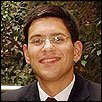
David Miliband MP - Member of the Group of Laeken, a consultative group for Guy Verhofstadt, Belgian prime minister and EU president-in-office.
David Miliband MP
Question: What has been the main outcome of the Laeken group's deliberations?
David Miliband: To help set the agenda or discussion by the heads of government at the Laeken council. I would hope that we have been able to provide a variety of views from around Europe to help develop a wide ranging agenda for the three years running up to the inter-governmental conference in 2004.
Question: Is there any one issue that leaps out?
David Miliband: I think first there's a very strong view that institutional reform must be driven by clear policy outcomes. Secondly the need for a rebalancing of the EU between its traditional economic and social functions, the "first pillar" of the EU, and its newer functions in relation to foreign affairs and defence, and justice and home affairs. And I think since September 11th it's clear the EU is going to have a growing role in those second two pillars, rather than being simply confined to the first. And I think the third thing that's come through our discussions is that we need to strengthen the creative tension that exists between the main institutions of the European Union - the national governments, the European Commission and European Parliament, and I think we have clarified that the reform of the Council of Ministers should be central in the debate in the run up to the inter-governmental conference.
Question: Has the Europe debate been transformed since September 11th?
David Miliband: I think that everyone says that nothing will be the same again since September 11th, but I would hope that Europe was moving into an outward looking phase in any case, that it was recognising the growing importance of what went on outside its borders, as well as within its borders. But obviously September 11th has given added impetus to the contribution that the EU can make in foreign defence policy and I suppose the security policy as well, which includes internal measures like the arrest warrant which will hopefully be agreed at the weekend.
Question: If Europe is going to move on issues like foreign defence or domestic security, does that mean all countries of the EU must rethink old fashioned notions of sovereignty?
David Miliband: I think that the debate about sovereignty around the EU is a relatively mature debate actually. Most European countries are used to being members not just of the EU, but of NATO and even the UN. And I think that it's clearer and clearer to most people that we're living in a world that is getting smaller - that interdependence is the defining feature of international relations. In that context it's important for all the nations to come together to exercise collective power, rather than just relying on the individual efforts of individual countries.
Question: What does that actually mean in terms of council's decision making and the vexed Qualified Majority Voting question?
David Miliband:I think that the QMV question is less vexed than the rhetoric would suggest because actually it's hard to find anyone with specific proposals to extend QMV. QMV operates over 80 per cent of council business and there's some degree of equilibrium in the balance between unanimity and QMV, with unanimity reserved to the key items that countries feel they need to hold onto themselves. The notion of pooling sovereignty is not a new one, but I think that as people realise that more and more problems do cross national boundaries - everything from the environment, crime, to foreign policy. It's in that context that countries want to join transnational bodies that can embody their own values as well as their own interests.
Question: In that context, is the reserved area on vetoes something that's fixed or do you think it will change over time?
David Miliband:I think that in areas like foreign policy, tax etc it's hard to see much change, and I don't see a great demand for change. I think that the EU has substantial powers, it's developing them in a flexible way and I think that's to be applauded. What we have to do now is develop, or reform, our institutions so that they can deliver on the aspirations that European leaders want from them. I've coined the idea of a delivery deficit in parallel with a democratic deficit, which is much better known. It's not really true to say that somehow Europe has broken down and failing, because in areas like the launch of notes and coins, the enlargement negotiations, cooperation on Justice and Home Affairs and defence, Europe is actually doing a lot and it's rising to some challenges. But there are areas where delivery does not match rhetoric and that needs to be addressed by the reform process which goes through the convention next year, and then up to the inter-governmental conference in 2004.
Question: What areas would be top of that list?
David Miliband:Well, the Nice European Council a year ago set out four areas: the charter of rights, the role of national parliaments, treaty simplification and the delimitation of competences. I think that the real tests for the EU are about addressing the issues of concern to people - so jobs, security etc, secondly addressing those issues in a global context because we can't only think of Europe introspectively - we have to look at it in a global context, and thirdly we have to look at tomorrow's problems not just today's because otherwise we'll find institutional design falls behind. I think that raises a number of key issues: first, reform of the European council. I believe that Europe needs a clearer, leaner, strategic function exercised by European council heads of government. Each council should elect a chair for 2 and a half years which could give leadership in that area. I also believe that it would do much to bridge the disconnection between European governments, and European citizens if council meetings, when they're legislating are held in public so that people can see the arguments and decisions that are being made. Secondly, I think that there is an important job to be done to entrench subsidiarity - people are wary of competence creep, a tendency of any organisation to a accrue power to itself, and not just in Britain but in the German Lander, there's strong demand for the limits as well as the necessity of European power to be set out. I think that can be done legally in the European treaties, and it can be done procedurally, for example involving the national parliaments. So I think that's an important agenda, because it will ensure, if we get it right, that Europe is focussing on the things where it can genuinely add value not poking into what Douglas Hurd used to call the "nooks and crannies" of national business.
Question: Peter Mandelson has suggested a European Industrial Energy tax to combat climate change. Is that the kind of area where the EU could do more?
David Miliband:That's certainly a bold move and I don't think it should be ruled out. I think you have to look at that against a range of other possible mechanisms for addressing the Kyoto commitments that European countries have and which they are implementing at national level - there's a Europe wide commitment, and then individual countries are allocated portions of their commitment and portions of the target, and different countries will want to do it in different ways. Even at European level, one can think of a number of approaches addressing an energy tax is one, and an emissions trading system which is going to be piloted in the UK is another. So I think that one should be relatively pragmatic about which approach should be taken.
Question: How does the public disconnection from EU institutions impact on the sovereignty debate?
David Miliband: Thirty per cent of people turn out in local government elections and the problem there is not the distance from the town hall to the street round the corner, so I think one has to be careful in believing the Europe has a unique problems of disconnection, and I'm nervous of saying that somehow the EU is uniquely disconnected from ordinary people's lives. What is true is that Brussels is further away than the town hall, and Europe then has a special responsibility to show where it's making a difference. I think that's why the delivery deficit is as significant as the democratic deficit for the leaders of the EU to address in the next few years. Personally I think that opening up the council of ministers will do a huge amount to demystify much of European governance and I think that can only be a good thing.
Question: Do you think that with some of the reforms you've been talking about in Europe could actually reconnect some British voters who are disillusioned or unconcerned domestic with domestic politics?
David Miliband:I'm not sure about that. I think we've got a job to do internally and it's unlikely that Europe would be able to solve it for us. I think changes in local government or modernisation of national politics has to proceed as well, but we're living in an age when voters are more demanding, when they're less likely to take what they're given, when they want a more interactive engagement with those in power. ePolitix is a symptom of that with online debates and the like. I think in that context, it's incumbent on all those who are in positions of power to think of ways that do genuinely connect people to the political process. And that connection can be in the form of openness of information, as well as direct democratic input.
Question: Should the directly elected European parliament be given greater role?
David Miliband:I think if you compare the drum beat in advance of this intergovernmental conference to that in advance of previous ones, you'd see a marked change which is that in the past, parliament has approached IGCs determined to get more power and often it's succeeded. This time there's less of that clamour. I think MEPs recognise that their job now is to use the significant powers that they have recently acquired, and I think that the issue now is how the European Parliament uses its powers rather than giving it new ones.
Question: Peter Hain recently said that time is running out for Britain to make its mind up on the euro. Is this a valid concern?
David Miliband:I think that the launch of the euro is significant obviously for Europe, but it's quite significant for us as well. It means that British citizens will have the euro in their pocket if they go to Ireland or the continent. I don't have a sense that anyone is challenging the timetable that has been set by the government, to come to a view early in this parliament, about the advisability or otherwise of joining the single currency. So I think the government's position on that is pretty sound.
Question: Do you think more could be done to turn around existing hostility to the euro?
David Miliband:I think that the most significant change in the next few months is going to be the existence of euro notes and coins themselves. I think that the success or otherwise of the introduction of the euro to the 11 countries who have already met the conditions and signed up, will be an important signal to people about whether this is a project they want to be part of or not. So I think that the deed of the introduction of notes and coins will probably have more effect over the next few months than any words that politicians can come up with.
|