|
End is nigh for last of the hereditaries
The prospect of an all appointed House of Lords has moved a step closer with the announcement of a bill to remove the remaining hereditary peers.
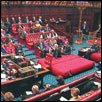
In the absence of any consensus on the next steps for Lords reform, the government wants to end the legislative role played by the 92 remaining birthright peers, leaving the chamber entirely appointed.
But the move could be defeated by a coalition of MPs and peers who are demanding more democracy in the upper house.
Constitutional affairs ministers will also move to take away the prime minister's powers of patronage by creating an appointments commission to select Lords "on merit".
"Legislation will be brought forward to reform the House of Lords," the Queen said in her speech in the second chamber on Wednesday.
"This will remove hereditary peers and establish an independent appointments commission to select non-party members of the upper house."
And the legislation will bring the Lords into line with the Commons' rules on membership by banning convicted offenders, including Lord Archer, from sitting in parliament.
"Centuries of government patronage in deciding the membership of the House of Lords would be ended by this Bill," said a Number 10 spokesman.
"The bill would create an independent appointments commission, which would take responsibility for nominating and then appointing members of the upper house.
"The bill represents a substantial diminution of the prime minister's powers of patronage. The appointments commission would be charged with vetting party political nominations and appointing new independent members able to bring skills and experience that would benefit parliamentary scrutiny and debate.
"It would actively seek representation from under-represented groups. It would be accountable to parliament rather than ministers. The bill would also bring disqualification for membership to the Lords in line with arrangements in the Commons."
But the Lords Reform Bill's chances of passing through parliament are under threat from peers who are refusing to back the move unless it is accompanied by an elected element.
Liberal Democrat constitutional affairs spokesman Lord Goodhart said his party would not support the measures.
Together with Conservative peers, who will also oppose what they see as the government reneging on a deal to keep the hereditaries until Lords reform is complete, the Lib Dems could block the legislation.
This would set Labour on a fresh collision course with the second chamber.
Some Labour MPs are also vowing to rebel over the government's support for the least popular option for reform in the Commons.
"The government needs to realise that Liberal Democrats - and many of its own supporters - are outraged at the way in which it has betrayed its own commitment to a full and democratic reform of the House of Lords," Lord Goodhart said.
"To call the government's present proposals reform is an abuse of the English language."
Conservative constitutional affairs spokesman Alan Duncan said an all-appointed house would rely too heavily on patronage.
"They must prove that their plans for the House of Lords are not just a plan to stuff the upper chamber with yes-men, happy to do the prime minister's bidding," he said.
"They must prove that, after the law lords attacked the government's criminal justice proposals, it is merely a coincidence that the prime minister wants rid of them.
"And they must prove, as the lord chief justice has demanded, that their reforms do not curtail the independence of the judiciary."
Campaign group Charter88 said the Queen's Speech was an example of government double standards.
"The Queen's Speech reiterated the government's commitment to brining democracy to Afghanistan and Iraq, but not to the House of Lords," policy officer Alex Runswick said.
"He [the prime minister] has once again ignored the will of the people and parliament who support a majority elected chamber."
|