|
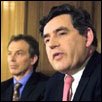
Blair rejects Brown's NEC bid
The prime minister has twice rejected Gordon Brown's request to sit on Labour's National Executive Committee, it has been claimed.
Tony Blair's relationship with Brown is said to have hit a new low after he refused the chancellor's second plea to join the party's governing body.
Blair has instead chosen to appoint two junior ministers - Hazel Blears and Douglas Alexander - instead of the chancellor.
The third seat is occupied by party chairman Ian McCartney.
"It is surprising, arbitrary and not in the best interests of the Labour Party," one "prominent Brownite" told the Guardian newspaper on Wednesday.
Blairites are said to believe that Brown would use a place on the NEC to extend his power base within the party.
The prime minister has also decided chair the party's 2005 general election strategy committee, a role performed by Brown in the two previous elections.
A Downing Street spokesman denied that the moves were designed to exclude Brown from key strategic decisions.
"The prime minister always appoints at least one woman and it makes sense for the other two people to be the chair of the party, Ian McCartney, and Douglas Alexander, who is chair of election planning," the spokesman said.
The NEC oversees Labour's election campaigning and internal organisation.
Most posts are elected by the party's various constituent members, but the prime minister retains the gift of selecting three members for the group.
The prime minister's official spokesman described the story as "blahtastic".
The relationship between the two men "continues to be one of the great strengths of this government" he added.
A spokesman for Brown said: "In the end these are decisions for the prime minister."
Speaking at prime minister's questions on Wednesday, Blair also denied there was any division between himself and Brown over the proposed EU constitution.
Liberal Democrat leader Charles Kennedy asked Blair how he could agree with both foreign secretary Jack Straw - who described the constitution as a "tidying up exercise" - and the chancellor, who warned of the threat the document posed regarding European tax harmonisation.
"Yesterday the chancellor warned of the threat of fiscal federalism," Kennedy said.
"With this difference of emphasis between the foreign secretary and the chancellor, who does the prime minister actually agree with?"
Blair replied that the government was united in its position.
"It is precisely because we are insisting that all the attributes of the nation state remain that we believe we will get the right outcome for this country in respect of the negotiations now going on at the Inter-Governmental Conference," he said.
"And the House of Lords European select committee agreed with our view."
|