|
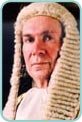
Profile: Lord Irvine of Lairg
While Lord Irvine is unlikely to face the same charges of treason after his departure from office, his tenure in government has proved almost as eventful as that of his 16th century predecessor Cardinal Wolsey.
One of the key figures in the first Labour administration, a series of controversial comments and disputes with other ministers appeared to increasingly erode his stature.
A strong defender of the judicial status quo, the impact of the decision to establish a ministry of justice would have been undermined had he been appointed as its first head.
The media identified Lord Irvine of Lairg as a poor political performer soon after his appointment to the Cabinet in 1997.
Perhaps the grandest of all ministers, he managed to provoke an early row by approving a £650,000 redecoration bill for his official residence.
The use of wallpaper costing £350 per roll caused a furore - and anger wasn't lessened when Lord Irvine said the hand-made flock wallpaper was not the sort of thing available at the "DIY store".
But he may have had the last laugh on the matter - it emerged later that guided tours of the lord chancellor's apartments netted £2 million for charity.
His lavish lifestyle, and generous capacity for fine wines, were never far from the headlines during his time in government.
Aside from the more trivial issues, Lord Irvine was involved in a series of key policy battles and chaired a succession of Cabinet committees.
On freedom of information he was reported to have clashed with then home secretary Jack Straw, pushing for a more radical commitment to open government that won praise from campaigners.
He also played a key role in drawing up Labour's historic devolution legislation.
Lord Irvine's role prompted commentators to regard him as one of the most powerful lord chancellor's in decades - exemplified by his close personal relationship with the prime minister.
In Tony Blair's days as a barrister, Lord Irvine acted as his mentor, and played a role in bringing the future prime minister into contact with a certain Cherie Booth.
It wasn't only political commentators who noted Lord Irvine's central role in the first Blair government.
In a comparison that drew much comment, he identified himself with Cardinal Wolsey, the man seen as the power behind Henry VIII's throne.
There were other rows too.
Lord Irvine came under fire for seeking donations to the Labour Party from legal professionals.
Many said that with the non-transparent system for judicial appointments - modified but largely retained under his stewardship - it was unclear whether they might be penalised for failing to hand over cash to the party.
And he faced a sexual discrimination suit in the appointment of Garry Hart, a close friend, as a special adviser.
Embarrassingly the country's most senior judge lost the initial case but later won on appeal.
In Labour's second term, Lord Irvine's conservative approach to reform of the House of Lords drew ire from many reform-minded Labour MPs.
In the run up to key parliamentary votes on the issue, the peer's position became increasingly at odds with that of former Commons leader Robin Cook.
On judicial reform, the lord chancellor made recent concessions on the need to make court proceedings more understandable for the public.
But he repeatedly clashed with home secretary David Blunkett on the role of judges in overturning government decisions in areas such as immigration policy.
In his letter to the prime minister on Thursday, Lord Irvine took a final swipe at Blunkett.
"I believe the office of lord chancellor has been of great historic value in our constitutional arrangements, especially in upholding the independence of the judiciary," he said in his resignation letter.
There was a further row over a £2 million pension fund and a possible £22,000 pay rise.
But his defenders point out that Lord Irvine gave up a successful legal career in order to spend just over six years at the heart of the Blair government.
He was born Alexander Andrew Mackay Irvine in a working class family in Inverness in Scotland on June 23, 1940.
Moving through Glasgow University, where he joined the Labour Party, he went on to Christ's College, Cambridge, where he graduated BA with first class honours with distinction in Law, and LLB with first class honours.
He lectured in law at the London School of Economics from 1965 to 1969 and was called to the Bar by the Inner Temple in 1967.
Lord Irvine became a QC in 1978 and was head of chambers at 11 King's Bench Walk Chambers from 1981.
He served as a Recorder from 1985 to 1988 and was appointed a Deputy High Court Judge in 1987. He ceased practice on becoming Lord Chancellor in May 1997.
His title comes from the village of Lairg in the district of Sutherland in the north east of Scotland.
He is said to have chosen Lairg as a title because of his family associations with the village.
His mother and maternal aunts, uncles and grandparents came from there.
|