|
Number 10 rejects Mandelson's euro warning
Downing Street has slapped down Peter Mandelson after his latest warning on the risks of staying out of the single currency.
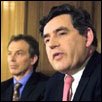
Number 10 said Tony Blair and Gordon Brown are still involved in the process of finalising the government's euro policy.
Only senior members of the government are aware of the state of play, a spokesman claimed.
Mandelson was speaking purely "as a backbencher on his own behalf", said Downing Street.
"The important thing is that the prime minister and the chancellor are meeting their colleagues, discussing what is one of the most serious issues that they are facing," said a spokesman.
"Only those involved in these discussion know the reality and know the substance.
"There will be all sorts of people saying other things and contributing to the public debate.
"But the important thing is what's happening in these discussions involving the prime minister, the chancellor and their colleagues."
Number 10 denied claims that Mandelson was voicing concerns raised by the prime minister.
But officials insisted they would not give "a running commentary" on contact between Blair and the former minister.
The move came amid criticism of Mandelson's intervention in the increasingly heated euro debate.
Speaking to women journalists on Tuesday, the former Cabinet minister launched a carefully timed attack on the chancellor.
The former Cabinet minister said the costs of Britain rejecting membership "would be incalculable".
"Our loss of influence and ability to shape vital decisions in Europe would be intolerable," he said.
"If we rule it out in this parliament, the people who will jump for joy and be greatly emboldened and energised will be the anti-Europeans in Britain; the Eurosceptic press, those who would be able to argue with some reason that they won the battle of ideals and that the government is seen off.
"Now is that what the Labour Party wants? Is that what the Labour government wants to see? I think not.
"It would be a great setback for the country, it would do damage to the government and to the New Labour project, and it would inevitably therefore to the prime minister as well."
The comments prompted senior Labour MP Clive Soley to warn against "vindictive briefings and personal feuds" over the euro.
Soley, a former chairman of the parliamentary party, said Labour must not allow arguments over the euro to spill out into the open.
"Policy differences in politics are an inevitable and healthy part of the democratic process. Vindictive briefings and personal feuds are not," he told the Today programme.
"In the past, Labour tore itself apart with such feuds and in the late 1980s the Tories began to do the same.
"Both the country and the party suffers when vindictive feuds creep into the political process. They should stop now."
The call was echoed by two other influential Labour backbenchers.
Tom Watson, a member of the Labour Movement for Europe, and Jon Cruddas, a member of Labour Against the Euro, issued a joint statement criticising Mandelson for breaching Labour's agreed policy that a decision on the single currency will be taken on the basis of the five tests.
"For weeks Mr Mandelson has been scurrying around Westminster, mounting a highly personal, shrill and divisive campaign using the single currency to divide the government, split the Labour Party and undermine the prime minister and the chancellor," they said.
"This campaign has now been exposed for all to see and it must stop immediately."
As the euro row deepened, Clare Short dismissed Mandelson's remarks as "obsessive mischief-making".
But she added that the government had already made its decision on euro entry.
"I understood that the prime minister and the chancellor had agreed that not yet, but keep open the possibility, depending on economic developments," she said.
The latest round of media briefings came amid a bitter internal feud over the single currency.
Pro-euro MPs insist that the door must be left open for a referendum during the second half of this parliament.
But many fear that Gordon Brown is seeking to rule out any move towards the single currency before the next general election.
Ahead of next month's announcement on the government's euro assessment, the chancellor claimed Britain could afford to go it alone outside the single currency.
Speaking to business leaders on Tuesday, Brown insisted that the government would take a decision in the national economic interest.
"We will have the strength to reject short term or quick fix options and we will make the right long term decisions on Europe," he told the CBI.
"So we will reject the view of those who would rule out membership of the single currency even if it were in the national economic interest to join."
And he vowed that the government would decide on the basis of a "rigorous assessment of the five tests that define the long-term national economic interest".
The opposition moved swiftly to capitalise on the latest bout of Labour bloodletting.
Shadow foreign secretary Michael Howard said the government was now "deeply divided" on the euro.
Labour in-fighting had become "vicious and personal", he claimed.
"As on foundation hospitals, as on Iraq, as on the euro: Labour is a deeply divided party," said Howard.
"It is quite clear that the fudged decision Gordon Brown makes on June 9 is going to be dictated by Labour's infighting, not what is best for Britain.
"Britain's national economic interest is coming a poor second to Labour's bitter and personalised faction fighting."
|