|
MPs demand evidence of Saddam's smoking gun
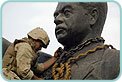 |
| Saddam toppled: Questions of legality? |
Pressure is mounting on the government to produce evidence of Iraq's weapons of mass destruction.
As the US announced it is sending 1000 experts to assist in investigations, reports suggested that Labour MPs are preparing for a fresh rebellion unless evidence of a smoking gun is found.
Scores of MPs said they backed the war on the basis of intelligence which made clear Saddam Hussein was in possession of a deadly arsenal of chemical and biological weaponry.
But the failure to uncover any weapons of mass destruction has led to renewed speculation that ministers exaggerated the risks in order to secure support for regime change in Iraq.
Sources say MPs were led to believe that ministers knew the exact location of Saddam's stockpile.
Now they claim they may have been duped into supporting the war and are demanding answers from ministers.
Amid anger at the situation MPs are calling for an inquiry into whether MI6 misled ministers about the scale of Iraq's weapons programme.
They question the veracity of the evidence circulated before the conflict and argue that the war may have been illegal.
David Hinchliffe, the chairman of the health select committee, told the Guardian newspaper: "For many of us who talked to ministers there was an implication that a lot more was known. Therefore a lot of people are anxious to establish the truth."
Fellow Labour MP and former minister Doug Henderson said the war would be deemed illegal unless evidence of Saddam's arsenal emerges.
But the prime minister has won support from one of the most prominent critics of the conflict.
Robin Cook - who resigned after warning that Iraq had no weapons of mass destruction - denied suggestions that the war broke international law.
"I have never believed that the prime minister would embark on a military conflict if he had thought it was illegal," he said on Saturday.
"I don't think the question is whether or not the military conflict was legal - the question is whether or not it was legitimate.
"For it to be legitimate there would have to have been a pressing and compelling case for military conflict.
"War should also always be a last resort. I felt in this particular case there were alternatives, and that there was not an immediate and compelling case for military action."
|


