|
Prodi backs France on Iraq
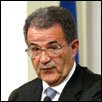 |
| Commission president Roman Prodi |
Brussels has thrown its weight squarely behind French UN opposition to UK and US-led efforts to disarm Saddam Hussein.
As Britain tries to rally support for a tough "roadmap" to peace for Iraq, European Commission president Romano Prodi, has moved to marshal the EU behind Jacques Chirac's UN security "Non" to a second Gulf war.
"By supporting the United Nations and the multilateral approach, by running the risk of saying what they think loud and clear, the French authorities are implicitly defending a certain idea of Europe, the idea on which European integration was founded," he told the French Assembly on Wednesday.
"When a political union emerges, it will reap the benefit of this lucid approach."
"I rely on the French to hold to their commitment to Europe, to support European integration and to make the efforts this demands."
"The challenge now is to ensure Europe has a role in the world. Without France, that ambition could not be fulfilled."
Prodi's move is a calculated snub to "new Europeans" such as the UK and Spain who, along with east European EU hopefuls have backed Washington's stance over Saddam.
As attitudes continue to harden in European capitals, the Commission is sending a clear signal to London that as the EU gears up for a key constitutional debate over its future, Britain's backing for military action could spell isolation.
"A war in Iraq. could have lasting repercussions for European integration. Because it calls into question the values we Europeans hold dear, such as our concern for peace, the rule of law and multilateralism," Prodi said in Paris.
Brussels has been dismayed as European member states fall out over what is regarded as "the first major test for the enlarged EU" and the Commission is seeking to capitalise on the row by pushing its vision for future foreign policy.
"European public opinion is slowly emerging and taking form," Prodi said.
"In particular, [citizens] want the union to ensure their security -- both at home and abroad. It is striking to see how public opinion is united across national borders in rejecting the prospect of a unilaterally declared war on Iraq. This is a sign that the peoples of Europe are moving closer together."
Brussels is seeking new powers for Europe that will see the EU "exercise the responsibilities of a world power".
Prodi, and the commission, are backing a proposal for qualified majority voting to replace a requirement for unanimity between EU member states on foreign policy issues - a demand firmly rejected by the UK.
And in his address to the French Assembly, Prodi mobilised the memory of Charles De Gaulle's hostility to American superpower status to highlight the dangers of "European schizophrenia".
"Allow the president of the Commission to quote General de Gaulle," said the Brussels chief.
"In 1967 he said that 'if a united Europe is to be built by itself and for itself without being subjected to an economic, monetary or political system that is foreign to it, if Europe is to counterbalance the immense power of the United States, then the ties and rules that hold the community together must be strengthened, not weakened'."Echoing Chirac, Prodi reminded countries set to join the EU in 2004 that their alliance was with Europe's political "project" first and the US second.
"We Europeans cannot go on indefinitely expecting the union to bring us prosperity and relying on the United States for our security. This is something I have often told the candidate countries. The European project forms a whole," he said.
Prodi's outburst coincided with a warning from external relations commissioner, Chris Patten, that unless the US had UN backing for a military onslaught in the Gulf the EU would think again about providing reconstruction aid for Iraq - Europe has already set aside 15 million euros for the country.
"It will be that much more difficult for the EU to co-operate fully and on a large scale. in the longer-term reconstruction process if events unfold without proper UN cover and if the member states remain divided," he told MEPs.
But he denied he was "issuing a threat of EU non cooperation"
"That is not my point. I am making, rather, a simple observation of fact: that if it comes to war, it will be very much easier to persuade. the EU budgetary authority to be generous if there is no dispute about the legitimacy of the military action that has taken place; about the new political order that emerges thereafter; or about who is in charge of the reconstruction process," Patten insisted.
"I am not making a quasi-legal point. I am simply offering a political judgement of no great novelty or sagacity. It seems pretty obvious."
|


