|
PM under fire in Scottish parliament
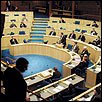
Tony Blair's tough stance on Iraq has been attacked by members of the Scottish parliament.
Debating the current international situation, backbench Labour MSPs were among those warning against going to war without a second United Nations resolution.
The debate was called by the Scottish National Party, which has been highly critical of the UK government's stance.
SNP leader John Swinney warned that the case for military action against Iraq had not been proven.
He told MSPs that British armed forces should not take part in any military action without a UN security council mandate that specifically grants authorisation.
Swinney also went further, arguing that a second resolution should be based on clear, compelling and published evidence.
He warned that military action at present could be a breach of international law.
He criticised the Westminster government for making extra funds available to the Ministry of Defence while not providing more for humanitarian relief.
"My position is that no case for military action against Iraq has been proven," Swinney told MSPs.
"As with all wars, there is one certainty. The people who will suffer most will be civilians. Innocent people will die."
Tony Blair also faced a stinging attack from Labour MSP John McAllion, who said that only the security council could ensure the legitimacy of military action unless it was taken as a measure of self defence.
"Under international law there is no such thing as an unreasonable veto," he said.
McAllion argued that it was a "sick mockery" to describe war as an act of humanitarian intervention on behalf of the Iraqi people.
He said the UK and US policy of sanctions had been responsible for hundred of thousands of deaths among Iraqi children
And he added that the decision to go to war now rested in the hands of president George Bush and Tony Blair.
"All that stands between war and peace is the democratic pressure that can be brought against those two politicians," he said.
He was "appalled" at the possible use of the royal prerogative to take the country to war without popular support.
Reflecting his party's national position, Scottish Liberal Democrat leader Jim Wallace said there was no doubt that Saddam Hussein was "an evil tyrant" but criticised the UK government.
"At the present time Britain and America sometimes give the impression that if they cannot get their way at the United Nations then they will by-pass it," he told MSPs.
He accepted that the threat of force had pushed Iraq to cooperate but called for weapons inspectors to be given more time.
Wallace also said that latest UK tests of Iraqi disarmament, such as a TV appearance by Saddam Hussein renouncing weapons of mass destruction, were proposals that "border on the ridiculous".
But with international relations reserved to the Westminster parliament, Wallace said the discussion was only "offering a view" to politicians in London.
"In the context of the present international responsibility we do have a clear duty of responsibility to the many diverse communities that make up Scotland today," he added.
Wallace, Scotland's justice minister, said the executive would not tolerate the stirring up of racial or religious intolerance.
Scottish Conservative leader David McLetchie questioned whether the Liberal Democrats would allow security council members such as China to exercise the veto.
The Scottish Conservatives also said that while a second resolution would be desirable, it would not be necessary.
But Labour MSPs continued to criticise the position of their colleagues at Westminster.
Johann Lamont said she was "deeply troubled" by the current situation.
She said there was distrust of American motives and cautioned against undermining international structures.
"There is a hunger, I believe, to know that we are not being duped by Bush," she added.
Labour's Pauline McNeill said MSPs did not have the same weight of responsibility as politicians at Westminster, but said it was necessary to respect all views on the issue.
"As clever as some of us like to think that we are, none of us can really be sure that their opinion is the right one," she said.
"But I believe the case for going to war has not been made."
Trish Godman, Labour MSP for West Renfrewshire, said that the justification for war was "unacceptably vague" and called for an end to economic sanctions on Saddam Hussein.
Susan Deacon said she could not support a course of action that lacked a clear mandate.
The Liberal Democrats' Keith Raffan asked: "If we embark on a policy of regime change, where do we stop?"
Nationalist MSP Nicola Sturgeon said there were questions over the motivation for attacking Iraq when North Korea was flouting the will of the international community.
She called for respect for "international law, not the dictat of the United States."
The SNP's George Reid warned that the killing would go on "long after the war is over".
Conservative MSP Lord James Douglas-Hamilton said the government should be given "total support" if they order the British military into action.
But defending the government, education minister Cathy Jamieson said that peace was not just "the absence of war".
She said that the parliamentary debate had reflected public opinion, and that all sides wanted to see a peaceful solution to the crisis.
Supporting the UK government meant showing support for the United Nations, Jamieson argued.
"We want all nations including the USA to work within the United Nations," she added.
"This is not a game or a debating contest, it is not about party political points."
She warned MSPs not to vote for any motion that undermined the chances of a fair and just solution to the situation in the Middle East.
Voting later in the day, MSPs backed the Labour position, prompting the SNP to say it was the only party that "spoke for and represented Scotland".
"Once again Labour had to rely on Conservative votes to support Tony Blair and George Bush's rush to war without UN backing," said Swinney.
|