|
Euro referendum in doubt
Treasury calls for further EU economic reform have left a question mark over whether the government will call a euro referendum.
Both the chancellor and the prime minister have voiced concerns over the pace of economic reform in a report published by the Treasury.
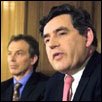
In a show of unity Gordon Brown and Tony Blair urged the EU to increase liberalisation of key markets.Brown said that increasing the momentum of economic liberalisation in Europe at a time of global uncertainty was vital.
"At this challenging time for the world economy each continent has to play its part to maintain the conditions for stability and growth," he said.
"While some progress has been made, the collective challenge we face is immense. Levels of productivity, employment and growth have consistently underperformed those of the US in the past decade."
With current tensions over Iraq and news that Blair's popularity is at its lowest-ever level at home, the report will be interpreted as a sign that a referendum on euro entry is likely to be delayed.
The report, "Meeting the Challenge: Economic Reform in Europe", details a long list of issues that the government wants answers for when the European Council meets next month.
"If Europe is to fulfil its ambition to be a world economic leader, and not remain vulnerable to the ups and downs of the world economic cycle, then it is vital that we demonstrate our commitment at next month's Brussels Council to implement the ambitious goals we have set for ourselves," said Gordon Brown.
Treasury officials say that while some progress has been made towards changing the European economy there is much more to do.
Gordon Brown has looked at the current problems in Germany which is struggling with a major recession and concluded that control of interest rates is a vital tool for individual countries.
"To be successful in EMU, countries need even more flexibility to adjust to change and to unexpected economic events, since the ability to vary interest rates and exchange rates within the euro area no longer exists," Brown said.
The key priorities for Brown are policies to boost employment, cutting restrictions to make labour markets more flexible, promotion of well-regulated, dynamic markets and a more strategic approach to competition policy.
The Treasury also wants to see new measures to promote research and development.
The prime minister backed Brown's reform agenda saying member states were "still not doing enough".
"We know what has to be done - to restructure tax and benefit systems to make work pay, to remove the self-defeating incentives to retire early, and to pursue active labour market policies that match new opportunity for the unemployed with responsibility on their part to take jobs," he said.
|