|
Cook backs 'substantial' democracy in Lords reform
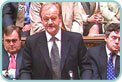 |
| Cook: pro-elected peers |
Robin Cook has mounted a stout defence of a largely elected House of Lords
Speaking as MPs and peers debated Lords reform, Cook dismissed those who were opposed to any elected element in the second chamber.
"This may be democracy, but not as we know it," he said. "It does seem to me that we will have difficulty carrying the public with us unless our reforms introduce a more substantial democratic element on a rather wider franchise."
He dismissed claims that an elected element would result in the House of Lords "getting above itself".
"Three quarters of the second chambers around the world are wholly or largely elected. Almost invariably the second chamber remains the subordinate chamber," he said.
"It is possible to keep a democratic second chamber subordinate by law and by convention. I do not believe it is possible to keep the second chamber subordinate by denying it legitimacy."
Former chancellor Kenneth Clarke said an elected House of Lords would bolster parliament following an executive-led attack on the power and influence of the Commons.
"There is no doubt that the House of Commons is far, far weaker than the one that I joined," said the Rushcliffe MP.
"A stronger House of Lords should complement this House."
Following press reports, a number of MPs expressed fears that Tony Blair is set to scupper plans to introduce an elected element to the second chamber.
William Hague, the former Tory leader, said he was "not wholly optimistic" that the reform process would lead to popular representation in the House of Lords.
He argued that reform should ensure that the second chamber is given "more authority and legitimacy".
Hague said a large number of elected peers would give the House of Lords greater authority to scrutinise government legislation.
"It is possible to govern with authority without being able to legislate with impunity," he added.
The debate follows the publication of the recommendations for stage two Lords reform drawn up by the joint committee chaired by former cabinet minister Jack Cunningham.
Speaking in the Commons, Cunningham said that Lords reform was an "issue of huge significance...and of great controversy".
After being unable to reach agreement on the future composition of the House of Lords, the committee drew up seven options - ranging from a fully appointed to fully elected chamber.
Once a consensus is reached on its composition, the committee will draw up final plans for the shape, powers and role of the reformed House of Lords.
Speaking in the upper house, Lord Howe said the committee had shown a "genuine sense of common purpose" in its deliberations.
"We need as much help as we can get from both houses, after consideration of each other's debates, if we are to make progress," he added.
Liberal Democrat frontbencher Paul Tyler challenged MPs who support a 100 per cent elected chamber to back a compromise deal.
He reminded them that "evolution, not revolution" often brings about substantial change.
"Those who wait for perfection wait for a very long time," he added.
Dr Tony Wright, the chairman of the public administration committee, reminded MPs that there were "dangers in going too far in either direction".
Former minister George Foulkes said he backed the "revolutionary" option of abolishing the House of Lords - a choice backed by 90 MPs but not currently on the table.
He said MPs who support scrapping the House of Lords should support retaining an entirely appointed second chamber in the meantime.
Foulkes insisted that a chamber of peers appointed by a new and independent commission would be "fair and transparent".
"We should do what we know to be right not what is seen to be politically correct," he added.
Senior Conservative Sir George Young noted that both houses were "partners not rivals" in attempting to hold the executive to account.
He favoured a one third appointed, two thirds elected balance where no single party would have a majority.
"It manifestly is not the case that a body can only work if all its members arrive through the same door," said Sir George.
Following a cabinet rift on the issue, ministers are to be given a free vote when both MPs and peers cast their votes on February 4.
The government had initially proposed a 20 per cent elected chamber, but backed down in the face of criticism from both traditionalists and modernisers.
Cook is one of the most prominent supporters of a largely elected second chamber.
But other senior ministers, including deputy prime minister, John Prescott, are vehemently opposed to such a move.
They believe any elected element will challenge the supremacy of the House of Commons and lead to calls for the second chamber to be given greater powers.
Cook said there was widespread agreement that the House of Commons "should remain pre-eminent" - but dismissed claims that this was incompatible with having elected peers.
"This chamber must remain the crucible in which governments are forged and reputations are made or broken," he said.
In the House of Lords, where a large number of peers are opposed to any elected membership, opinion is set to be more divided during two days of debate.
Many "expert" peers - who come from the professions such as science, medicine and industry - feel they will be squeezed out by elected representatives.
They argue that a reformed House of Lords could lose its independence of mind if its members have to fight elections.
But reformers are pressing for radical changes, despite opposition from some members of the government.
Liberal Democrat leader in the Lords, Baroness Williams, said that Lord Irvine had been wrong to suggest the choice was between a fully elected or a fully appointed upper house.
"The essence of politics is compromise. We all know that is the only way to make politics work," she told peers.
"I say with the greatest respect to the lord chancellor that it simply isn't the case that there are only two choices, because the choice of a hybrid house remains open to us all."
Ahead of the debates, constitutional reform campaigners Charter88 released details of a YouGov poll that found public rejection of an appointed second chamber.
It showed that just three per cent of those questioned favour a fully appointed chamber.
Eighty three per cent wanted more than half the second chamber to be elected.
Fewer than one in 10 wanted to continue with the majority of representatives in the second chamber being appointed.
"Our poll shows that the people of this country want genuine reform, and are fed up with a system based on appointment," said Karen Bartlett, director of Charter88.
|


