|
Blair quizzed on Iraq's terror links
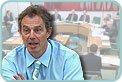 |
| Blair: hawkish performance |
The case against Iraq must be made on its own terms and cannot be directly linked to the war on terror, the prime minister has told a committee of MPs.
Speaking on Tuesday, Tony Blair played down suggestions that Saddam Hussein is linked to the al Qaeda network and may have been involved in the attacks on New York and Washington.
The prime minister said that there was no evidence to suggest that the Iraqi regime was directly involved in the current terror campaign.
Asked by members of the Commons liaison committee whether there was intelligence to support the claims, he said: "There is none that I know of that links al Qaeda, Iraq and terrorist groups in the UK."
The prime minister said there was a "potential linkage" between the two - but insisted that the case for military action against Saddam Hussein has "got to be made on its own terms".
Despite pouring cold water on claims that Saddam was directly involved with the al Qaeda network, Blair warned that there was evidence to suggest al Qaeda operatives were operating within Iraq.
"It would not be fair to say that there was no evidence to suggest there was no link whatsoever," he added.
"The actual position is that we can't be sure of the exact nature of what that linkage is."
The prime minister also warned that it was "not impossible" that Iraq was reconstituting its nuclear capabilities.
"We can't be sure how far along the path of the nuclear weapons programme they are," he said.
And he defended the government's decision to pursue disarmament through the UN - but repeated his warning that action must be taken.
"The UN has got to be a way of dealing with this issue, not a way of avoiding it," he said.
Blair expressed confidence that the security council would give the green light to action against Iraq if evidence of his arms arsenal is discovered.
"If the inspectors find evidence that amounts to a breach then the security council will authorise action," said the prime minister.
But he warned that any unreasonable attempt by a UN security council member to veto military action would stiffen the resolve of Britain and the US.
"We mustn't give a signal to Saddam that there is a way out of this," he warned.
Despite claims that Britain and the US are preparing to go it alone, the prime minister said there would be "further discussion" within the security council before any further action is taken.
He again insisted that a second resolution was "preferable" but not essential before military action could begin.
Pressed on the deadline for weapons inspections, Blair insisted that he would give the UN team time to compile a full report.
He warned that "this is not a game of hide and seek" and stressed that the process required the clear co-operation of the Iraqi regime.
"I have said that they should be given time to do the job and I am sure they will be," added Blair.
The prime minister admitted, however, that pressure was mounting on George W Bush to act alone.
"I think, no doubt, that there are voices inside the US that may want the US to go down the unilateralist route. But I don't think that's where George Bush is," he said.
And he insisted that Britain was still involved in diplomatic efforts to ensure that the world acts together against the threat posed by Saddam Hussein.
"I think it is our job to try and make sure that we gain the broadest possible international co-operation," said the prime minister.
"I think that the worst thing that can possibly happen is that the world divides up into the pro-American and the anti-American forces."
But he warned his critics that Britain was "going to be in the front line of this whatever happens".
"If we end up in a situation where there is a potential nuclear conflict every country in the world is going to be drawn into that in some way," said Blair.
"That is why I think there is no point in us thinking, and I don't think it is actually particularly in the British character, to think well let's go to the back of the queue and hide away."
In the early stages of his session before the Commons liaison committee, the prime minister also warned that terrorists would attempt to strike at British interests.
He conceded that an attempted terror attack was now "inevitable".
|


