|
Narrow victory for 'normal' Commons
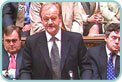
MPs have narrowly backed Robin Cook's modernisation of the House of Commons.
After a midnight vote following a traditional marathon nine hour debate, the Commons adopted its biggest shake-up in a generation.
But the move towards "normal" office hours generated deep divisions among MPs.
Pro-reform "Mods" backed the proposals as a family-friendly option that would make elected representatives more "in touch" with ordinary voters.
Traditionalists - including senior Labour figures - believe parliament is being diminished and turned into a legislative factory staffed by MPs who will be regarded as "lazy sods" by the public.
Plans will see the Commons sit from 11.30am - 7.30pm on Tuesdays and Wednesdays, rather than the current 2.30pm - 10.30pm session.
The Commons weekly highlight of prime minister's question time will shift from 3.00pm to noon on Wednesday and ministerial statements will be taken at 12.30pm instead of at 3.30pm or later.
Monday sittings will remain from 2.30pm to 10.30pm, to allowing MPs to travel from constituencies up and down the country.
Cook - who chaired the Commons modernisation committee that drafted the changes - welcomed backing for a "modern and effective parliament".
But the Commons leader acknowledged traditionalist strength of feeling against the reforms.
He argues that the reorganised sittings will not diminish parliament but will make the Commons more relevant and more media friendly.
"I am very pleased that tonight MPs voted for a more effective parliament. We have carried the recommendations from the modernisation committee," he said.
"The reason that I want the Commons to start earlier is in order for it to set the agenda for public debate."
"Now that the House has voted for change, I will want to work to convince those MPs who still have doubts and build a consensus behind a modern, effective parliament working more normal hours."
A Conservative bid to introduce sittings at Tuesdays and Wednesdays sessions at 9.30am were massively rejected - by 347 votes.
But morning sessions on Tuesdays nearly fell - scraping through with a paper-thin majority of seven votes.
An attempt to ditch early hours on Wednesdays, led by Gerald Kaufman and Chris Mullin, was narrowly defeated by 288 votes to 265 - a majority of 23.
Eric Forth condemned the modernisation proposals as "half-baked".
The shadow Commons leader believes the new hours will privilege ministers concerned with pushing legislation through parliament.
"I do not see this place as a legislative factory. I don't believe that we should measure ourselves by the ease in which the government gets its way - quite the opposite," he said.
"My avowed intention here is to make life as difficult as possible for the government in order to try to make sure what it does is properly scrutinised and that they are properly held to account."
Labour backbencher Brian Donohoe warned predicted that modernisation will not "add anything to the business of the House being exercised any better".
"It will send out the wrong signals to the public who will once again think that politicians are lazy sods and that because of that we will get a negative response which is the last thing that we need," he said.
As the debate moved on into the night MPs were bitterly divided over plans to radically overhaul the procedures and hours of the House of Commons.
As Cook sought to fend off a revolt over plans to wind-up Commons business at 7.00pm two nights a week, he made an impassioned plea for MPs to bring parliament into the modern age.
Amid backbench manoeuvres as Tories joined forces with Labour rebels to defeat him, the Commons leader said he loved parliament and warned it would fall further into contempt unless MPs backed change.
Presenting the case for an end to late night Commons sittings, shorter recesses and moves to make debates more topical, Cook mounted a robust defence of his reform agenda.
"I want the Commons to remain the great forum of our nation in which the views of the public find voice and in which their opinions are heard," he said.
"A Commons which derives its authority from the respect and trust of the public and because of that authority remains the crucible in which governments are forged and are broken.
"To retain that public support, the Commons must accept reform. I ask all those who share my love of this place to demonstrate it tonight by voting to bring it into the 21st Century."
Cook said that the House of Commons was facing a "long term challenge to its legitimacy".
He urged MPs to accept responsibility for the "out of touch" and "eccentric" procedures of parliament.
"The best case for modernisation is that this House will lose its authority if it is seen by the population to be out of date," he warned.
"This is a parliament with a long history, stretching back over eight centuries," he said.
"That history can be a strength to this place. But it can also be a trap if we become too attached to our procedures because that is way that in which we have always done things."
Facing strong criticism from the Opposition frontbench, Cook warned against "resisting change that is necessary to keep change of a rapidly changing world".
His comments came during the opening session of a seven hour debate into Commons modernisation.
Plans to reduce the Commons recess and wind-up parliamentary business in the early evening are bitterly opposed by some MPs.
The shadow Commons leader Eric Forth said MPs should be forced to "adjust and adapt" to the hours and stresses of parliamentary life.
The knife-edge vote became a battleground between traditionalists and modernisers and split opinion along the North-South divide.
Despite putting on a strong Commons performance, Cook faced criticism from political opponents and supporters alike. In the first three hours of debate fewer than five MPs had spoken out in favour of early adjournments.
The Labour MP Chris Mullin said early sittings would result in MPs "wandering the streets of the West End with too much time on their hands and too much money in their pockets".
"If I was a spouse living several hundred miles away I would prefer to know my other half was snug in the warm bosom of the mother of parliaments instead of roaming the streets of the West End with too much time on their hands and too much money in their pockets," he said.
Despite the claims, Cook insisted that the reform package would ensure that parliament became more efficient and will encourage more women to stand for parliament.
He said that most MPs would continue to work for 60 hours a week - but stressed that they would work at a more sociable hour.
"We are all busy people. Most of us will be back at our desks in the early morning," he told the Commons.
Cook warned that TV coverage of MPs sitting well into the night gave the impression that politicians were "daft".
Traditionalists said that Cook's move was wrong - arguing that parliament should sit for as long as it takes to scrutinise legislation and the work of the government.
Eric Forth, who believes that the Commons should convene in the morning and adjourn once business is completed whatever the hour, headed opposition to Cook's blueprint.
"I believe that everything that the government is proposing makes life easier for MPs and easier for the government, and that surely isn't what parliament should be about," he warned.
"The House of Commons should be a vibrant place holding the government to account, making it difficult if necessary for the government.
"And I don't see that any of the proposals that are going to be before us do any of that at all, in fact quite the reverse.''
|