|
Government to overturn Lords adoption setback
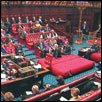 |
| Lords: no to gay adoptions |
Ministers have vowed to overturn a Lords vote blocking adoption rights for unmarried, gay and lesbian couples.
Moves to reform adoption laws were defeated by a packed House of Lords on Wednesday night.
The government has pledged to strike down the Lords amendments when the Adoption and Children Bill returns to the Commons.
But time is tight for ministers who must drive through the legislation before parliament's new session on November 13.
MPs and the government are resolute ahead of another confrontation with the Lords.
Peers voted by 196 votes to 162 to maintain the ban on unmarried couples, including same sex partners, adopting children.
Twenty Labour peers backed a Conservative amendment and 48 crossbenchers and two bishops joined the revolt.
Prominent Labour Muslim peers Lord Ahmed and Baroness Uddin were among those voting against the government.Social services minister, Jacqui Smith, expressed her "disappointment" and committed the government to reversing the setback.
"I am disappointed that the Lords have voted in favour of restricting potential adoptive parents to only married couples," she said.
"The Commons overwhelmingly endorsed the need to widen the pool of potential adopters, ensuring that more children are adopted from care and placed with stable and loving families."
"Given the strong views of the House of Commons on this issue the government intends to allow another free vote once the Bill returns to the House of Commons."
Smith said that the government's aim is to "ensure that more vulnerable children have the chance of family life that adoption can bring".
"By allowing unmarried couples to adopt together, we would give children the security of having a permanent legal relationship with two parents," she insisted.Despite the government's insistence that the measure will be supported the future of the adoption reform is not clear.
After a long and heated debate peers may again defy the Commons and kill the move when the legislation returns after a further vote by MPs.
Conservative spokesman, Earl Howe, based opposition to the bill on arguments centred around safeguarding stability for vulnerable children.
"Adopted children need stability and permanence in their lives," he said.
"Statistics show clearly that couples who commit themselves to marriage stand the best chance of having a stable and enduring relationship.
"Unmarried couples and same sex couples are very much more likely to split up than couples who are married."
His argument was countered by health minister, Lord Hunt, who accused the Tories of denying thousands of children in care the chance of a normal family environment.
"Can we really say that in every single case a married couple should take precedence?," he asked Conservatives.
Hunt confronted the marriage and same sex issue by claiming the bill's opponents backed a "hierarchy" of relationships over the interests of children.
"When it comes to making individual judgments about couples who have applied for adoption, it cannot be made on the basis of a general hierarchy of relationships," he said.
"The critical issue surely is how suitable that couple are to take on parental responsibilities."
Leading the moral charge against reforming ministers was the Tory Baroness O'Cathain.
She told peers how she was called by Baroness Young to take up the fight for family values just 12 hours before she died last month.
She argued that the a shake-up of adoption and care, led by Tony Blair, had "already borne fruit".
Highlighting statistics showing a 60 per cent increase in adoptions - from 1,900 in 1997 to 3,100 in 2001 - O'Cathain stressed that most adopters had been put off by politically correct bureaucracy.
"Those that were turned down were sometimes given the reasons like 'you're too rich, you're too poor, you live in too big a house, you have too many books, you go to church'," she said.
Backing reform, she insisted change to the ban on unmarried couple was unnecessary.
"When this bill becomes law, the government hopes - as do we all - that these ridiculous attitudes should be a thing of the past and the process put in place should guarantee that many more would-be adopters ... will have their wish fulfilled and many more children will be adopted," she said.
"There is certainly no need to extend the range of would-be adopters from the current situation of married couples and single persons."
|


