|
Prime minister calls for renewed effort to save planet
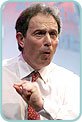 |
| Blair: more must be done to heal scar of poverty |
The prime minister has told the Earth Summit that the Kyoto protocol is right "and should be ratified by all of us".
The warning to the US came amid 11th hour horse-trading over plans to set new targets for the use of renewable energy sources.
In a speech to the Johannesburg Summit, he made the case for alternative energy and a renewed effort to "heal the scar" of poverty in Africa.
He said that world leaders must ensure that they balance economic growth with the need to ensure that the planet is protected.
The prime minister called for greater leadership in a "world of interdependence".
"None of this is easy, the short term clashes with the long term," he conceded.
Stark warning
Blair warned that the cost of doing nothing was "not unknown" and could "spell catastrophe for our world".
"We know the problems. A child in Africa dies every three seconds from famine, disease, or conflict," he said.
"If climate change is not stopped, all parts of the world will suffer, some will be destroyed. We know the solution: sustainable development. The issue is the political will."
The prime minister warned that Johannesburg was simply a staging post to a more radical programme of change.
"Development, for us, is a priority. Africa, for me, is a passion. Proud of our leadership on debt relief, we know there is more to do. Proud of the extra resources we are giving to aid and development, we want to give more in the future, and we will," he said.
"Proud that we will meet, indeed exceed our Kyoto targets; and we must go further."
"We must open up world trade, and that must include the developed world opening up its markets to the products of the developing world - especially for agriculture," he added.
"It means sustainable and fair development, globalisation with justice, ensuring its benefits are spread. It means driving through the Partnership with Africa.
"Britain will raise, by 2006, its commitment to development aid to Africa to £1 billion a year and its overall levels of assistance for all countries by 50 per cent."
Action not words
The Tories said Blair's speech was long on rhetoric but short on actual policy commitments.
Shadow international development secretary, Caroline Spelman, said: "The government have put their heads in the sand on the subject of debt relief and are unwilling to admit that the process of debt relief is failing.
"Trade rules discriminate against poor countries, but there has been no concerted effort to reform them. We welcome the extra money allocated to Africa - although this was announced several months ago.
"People have grown cynical of speeches big on rhetoric and short on delivery. Tony Blair's pledge to heal the scars of Africa may have been applauded at the Labour Party conference, but in a region gripped by famine they ring hollow unless they are followed through with deeds."
Malcolm Bruce, the Lib Dem environment spokesman, said: "Tony Blair will be judged by the 10-year implementation plan, not a five-minute speech in Johannesburg.
"His strong words on the Kyoto agreement are particularly welcome but this needs to be followed by action. The Labour government is very good at setting environmental targets but falls down on delivery.
"The fact that UK emissions are rising despite the Kyoto commitment is testament to this.''
Summit continues
Despite the stalemate over renewable energy, negotiators in Johannesburg reached agreement on climate change, trade and sanitation after a marathon session of discussions on Sunday night.
The US is, however, opposed to plans to set any new targets on global warming.
Speaking on Sunday, Blair said America must be persuaded to change its views on climate change.
During a speech in Mozambique the prime minister confirmed his support for the Kyoto agreement.
President Bush has instructed his team in Johannesburg to remove all mention of the Kyoto protocol.
Despite US efforts to ensure there is no mention of Kyoto in the final 30,000 word "plan of action" Blair sought to highlight its importance.
"In truth Kyoto is not radical enough. Yet it is, at present, the most that it is politically doable and even then the largest nation, the US, stands outside it," he said.
"They accept the science but believe the targets are unachievable without unacceptable economic consequences."
|


