|
Report endorses e-voting
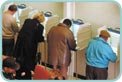
Trials in electronic voting conducted at the local elections earlier this month have been hailed a success in a new report.
Recommendations to continue pilots have been accepted by the government, along with proposals to increase voter education about the technology.
Ministers also back moves to continue offering postal voting as an option and decentralise the process to the regions, to prevent fraudulent activity and hacking.
The report, by De Montfort University, found that there was public support for electronic voting among groups who would not necessarily use the technology - such as the elderly.
But where there was a choice of the traditional ballot box or the electronic methods, voters preferred the existing method.
A number of people expressed fierce opposition to change and barriers to successful e-voting were identified.
These included concerns that the security of the system was more vulnerable than the traditional voting methods and that access to the technology is insufficient, leaving digital television as a potentially more successful system than the internet.
Secrecy was also an issue, the report found.
There are also issues of voters' technical ability = given that much of the electorate is unlikely to use the technology on a day-to-day basis.
Local government minister, Nick Raynsford, welcomed the report's endorsement of pilot schemes, which are now expected to continue at the next local elections.
"This is a phased programme in which we are proceeding in a very measured way in a series of pilots, all of which will be thoroughly evaluated by the independent electoral commission, as well as drawing on the benefits of research," he said.
Although costs of future trials will be incurred by companies developing the technology, the pilots cost the government £4.1 million this year, with further costs expected.
However, Raynsford expressed little concern over future funding. "This is part of a structured programme of research, and doesn't involve a big bang approach," he said.
But there were also divisions over the "multi-channel" approach to the pilots.
Speaking in the Commons on Tuesday, local government secretary, Stephen Byers, announced the possibility of a purely postal European election in 2004.
Today's report recommends that voters have a choice in the method of voting. "We don't want to close off options unnecessarily," said Raynsford.
"We have to make judgements about what are the best options which of those options can be handled in a way that avoids potential risks of fraud or impersonation, which make it easier for people to vote, and we've been doing that."
|