|
Cook: 'No delays' on Lords reform
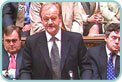
Plans to seek consensus on Lords reform will "clear the roadblock" for change and will not delay progress, Robin Cook pledged on Tuesday.
Responding to claims that the government had kicked reform into the "long grass", the Commons leader told the BBC that the pace of progress would be set by parliament and, depending on the decisiveness of free votes in both houses, should be in place for the next general election.
"It's not a delaying tactic," he said. "This is a way of making progress in a parliamentary way. It's making a democratic decision - in the hands of people who represent the public."
During a Commons statement on Monday, Cook said that there should be no "repeat of past history in which reform has been delayed because those who wanted it could not agree".
Over recent months the government's plans have been hit by disputes over the proportion of elected members in a reformed House of Lords.
The leader of the Commons said the government had "listened carefully" to the views of both Houses in considering how to move forward, and would now establish a joint committee of MPs and peers.
"On this vital constitutional issue, which concerns not only the composition of the House of Lords but the role of parliament as a whole and the relations between the two Houses, we have decided that it would be right invite the two Houses to establish a joint committee in the hope that we can forge the broadest possible parliamentary consensus on the way forward," said Cook.
The Conservatives and Liberal Democrats had previously called for such a joint committee to be set up, and Cook said he looked forward to their co-operation.
The committee would be set up "as soon as possible," he pledged.
It would report on a range of reform options, including fully nominated and fully elected option.
Both Houses would then be given free votes on the proposals, said Cook.
After the votes, the committee would develop more detailed plans taking note of how the MPs and peers voted, and including transitional strategies.
The government would then bring forward legislation based on the committee's report and the opinions of both Houses, he said.
The Commons leader warned that those seeking reform of the Lords should take the opportunity presented by the free votes to unite around a common position.
"We must not allow a repeat of past history in which reform has been delayed because those who wanted it could not agree and therefore left the field to those who opposed it," said Cook.
The shadow leader, Eric Forth, said the announcement was a "fine mess" that amounted to an "indefinite postponement".
"But having said that, I of course welcome the establishment of the joint parliamentary committee," he added.
Broad consensus
Ahead of Cook's statement, Lord Irvine said that ministers aim to "forge the broadest possible consensus" on the next step of Lords reform.
The lord chancellor, who was the joint architect of the government's plans, told the Lords that no options will be ruled out in advance.
The move follows a cabinet stalemate over the government's plans for reform of the upper House.
In a move that will be widely regarded as a compromise following stiff opposition to Downing Street's blueprint for change, the lord chancellor said both Commons and Lords would be able be able to record their views in free votes.
"It is right that parliament itself should record its views on the composition of the second chamber," said Irvine.
Existing proposals for "second stage" reform have continued to cause difficulty for Downing Street, with reports of cabinet splits over the proportion of elected members of the reformed upper House.
Plans previously backed by Tony Blair and Lord Irvine suggested a 20 per cent elected, 20 per cent independently nominated, and 60 politically appointed composition for revamped second chamber.
Outflanked on the issue by the Tories, who favour an 80 per cent elected model, the government has faced stiff opposition from many of its own backbenchers.
Cook has been leading calls for a compromise deal of around 50 per cent elected and 50 per cent appointed. He praised the position again when he spoke in the Commons on Monday.
Campaigners welcome 'victory'
The government's announcement has been welcomed by groups beyond Westminster.
Karen Bartlett, director of constitutional reform campaign group Charter88, said the announcement was a "victory for those campaigning for a democratic UK".
"A joint committee should not be used to try to minimise the proportion of elected members by conceding ground to peers. They were isolated as the only group to favour a mainly appointed second chamber in response to the government's white paper and should listen to the overwhelming weight of opinion," she said.
"These proposals must not be used as a delaying tactic by the opponents of reform. There is no reason why a Committee should not meet and report quickly."
|