|
Byers row was 'personality clash' says Mottram
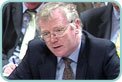 |
| Defence: Mottram |
The row that engulfed Stephen Byers' department was "a personality clash on a big scale" according to its head civil servant.
Appearing before the public administration committee on Thursday, Sir Richard Mottram sought to dampen the row that had claimed the jobs of Jo Moore, Martin Sixsmith and Ian Jones.
In a move which will anger his critics, Sir Richard admitted that some of his conversations with Sixsmith concerning a future post in the civil service were to "jolly him along".
He told MPs that he knew it was unlikely that Sixsmith would be offered another civil service post.
The permanent secretary told Sixsmith that he was "not sure that the secretary of state (Byers) would think this is a good idea".
Sir Richard confirmed Byers' statement that he had expressed the view that Sixsmith should not remain in the civil service but could not block such a move.
According to the career civil servant Byers' opinion was irrelevant given that other parts of the government machine had also formed a similar idea.
"My secretary of state was not the only person who was pretty peeved with Mr Sixsmith," Sir Richard told the committee.
The two warring media aides had to go for different reasons - Sixsmith because "things were being done to get Jo Moore" and Moore because "she had become the story".
With the removal of the two central characters complete and a third suspended, Sir Richard confirmed there would be no more departures from the media unit.
"I do not envisage others being suspended," he said.
There were "no big lessons for the system" to learn from the debacle - though he said that personally he had learnt that "openness isn't always a good idea".
He confirmed that he had told Sixsmith the now infamous appraisal of the situation that "we're all completely fucked".
Sir Richard sought to put his remarks in context saying it was "one of the most tedious subjects I've ever had to deal with".
His remarks had been private and though the situation had been serious it was relative. In his time as a civil servant he had dealt with issues to do with nuclear war.
"They're not in that category," he said referring to the department's problems.
Moving on to the relationship between ministers and civil servants he said that Byers held a positive view about the work of civil servants though other ministers misunderstood the role of Whitehall mandarins.
"Ministers don't understand. It's like a rather stupid dog," he said explaining all civil servants wanted to do was serve their masters as well as possible. "Above all it wants to be loved for doing it.".
Replying to claims that Labour Party chairman Charles Clarke had accused Whitehall of being obstructive, Sir Richard said: "If he said that I think he misunderstands the way civil servants think about ministers."
The row began over the moving of the department's former media chief Alan Evans when Stephen Byers had arrived at the department. Evans had been brought in because John Prescott had wanted someone who would give weight to strategic planning over media issues and Byers had wanted a spin doctor, he said.
This was standard practice in Whitehall and Evans skills were not suitable to the new role. There was a "perfectly defensible set of reasons" for moving him, he said. The problem was that staff had interpreted this differently and that "managing myths" had not happened. It had been localised only to the press office and did not represent the whole department.
"There was never a problem over a dysfunctional department," said Sir Richard.
|


