|
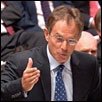
Blair gets rough ride at PMQs
Tony Blair has faced a grilling in the Commons from the Conservatives and one of his own backbenchers.
The prime minister was taken to task on Wednesday over Alan Milburn's announcement of plans to allow top NHS hospitals to become independent of Whitehall control.
It was a clear indication of the battle the government faces over public services and how Number 10 perceives its opponents. Blair sees a three way fight between himself and the Conservative option of privatisation as well as old fashioned nationalisation.
His weekly session at the dispatch box did not get off to a good start, when he mangled the answer to his first question on investment - and it did not get better for him.
"Education results have gone up, waiting lists have gone up," he said, continuing to howls from the Tory benches "police numbers have gone up, the number of nurses have gone up" before correcting himself.
Iain Duncan Smith clearly relished the exchanges and began with transport.
"When did the 10 year plan for transport begin? In 1999 when his deputy prime minister announced it or on Monday when the transport secretary announced it again?"
Blair regained his composure to repeat his charge that the Conservatives were interested in cutting the government's planned investment.
"That would make more sense if it weren't for the fact that over the last two years they have announced the same policy five times and the same money at least four times. In that time the prime minister's team have backed privatisation, he's renationalised the network, he now wants to go cap in hand to private industry to get extra funding and yet the figures show the delays before the strike have risen by 61 per cent," Duncan Smith replied.
He added the City now favoured investment in Mexico before they would risk money in the UK. That made transport secretary Stephen Byers the most expensive cabinet minister in history
Blair repeated his argument on investment. Either he forgot or his patience has run out, as the customary defence of Byers was not forthcoming.
The real battle of the session came over the NHS which started with a question from Tory backbencher Michael Jack over funding. The prime minister soon found himself floundering.
Forced on the defensive, Blair claimed progress was being made and the Conservatives wanted to charge people to use the NHS.
Duncan Smith was not prepared to let the argument stand.
"When he told NHS executives he would, and I quote 'come down like a ton of bricks' on anyone who had anything to do with the private sector, what did he mean by that?"
Blair admitted that the health secretary had announced "a whole series of partnerships with the private sector" which brought stony faces to Labour's left-wingers.
Dennis Skinner, often animated at PMQs, sat in silence leaning forward as the prime minister said it was very, very sensible to work with the private sector and providing good service was what mattered.
Duncan Smith came back with further taunts.
"Yesterday, the prime minister and his health secretary apparently hated the private sector. Now its clear they've turned to it in desperation," he said. Alan Milburn had performed a u-turn over whether the NHS should be a monopoly provider.
Blair called for a "real debate" and for the Tories to say what their real plans were for the NHS.
"It's no good the prime minister asking me what I support when he doesn't even know what his own government supports," snorted Duncan Smith.
"I suppose for the right honourable gentleman that's what passes for stinging rhetoric," snapped Blair, attempting to land one blow.
It was not enough for Labour's left-wingers and backbencher John Cryer signalled he wanted to ask a question which the Speaker allowed.
To roars from the Tory benches he asked: "After the examples of Equitable Life, Railtrack and even Johnson Matthey, why should we hand over chunks of the health service to private sector managers? Could the prime minister tell the House how these whiz-kids from the private sector will supposedly transform the health service when he said quite rightly the health service is getting better under Labour?"
Blair disagreed with his backbencher as PFI deals were delivering and the Tories were against investment. The government's plan "is absolutely the right position".
Both Liberal Democrat leader Charles Kennedy and father of the House Tam Dalyell questioned the treatment of Afghan prisoners and the bombing campaign.
The prime minister defended the treatment of Afghan prisoners by the US government, reinforcing the government's line that the detainees were "highly dangerous people" and there were still pockets of al Qaeda resistance. The prisoners would be treated humanely. "War is always a bloody and difficult business," he said.
The prime minister's ill temper showed again with a snap at Kennedy's second question. "With respect he should have been listening to what I've been saying," he said.
In answer to a question from a Labour backbencher on the day an anti-hunting group claimed it had support from 412 MPs, Blair said there was a manifesto pledge to hold a free vote on hunting but refused to indicate how long it would be until it is held.
|