|
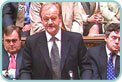
Cook outlines Commons reform plans
The leader of the Commons, Robin Cook, has published radical plans to reform the way MPs do business.
He said that voters had grown increasingly disenchanted with the public image of parliament.
"The greatest gain from reform will be to democracy. One of the factors in the declining turnout at general elections has been the decline in the public esteem shown for parliament," he said.
"One way to regain that esteem is to convince people outside that we are effective in our scrutiny of government and legislation, and that we use our time efficiently. That verdict of the public must be the spur to reform and, ultimately, will be the test of its success."
The Commons leader has called for a shorter parliamentary week, with a greater emphasis on "family friendly" sitting hours.
He is also planning to change the timing of prime minister's questions.
Under the new regime statements would be heard at 10.30am on Wednesdays and Thursdays - making way for a greater number of short debates in the afternoons.
"Modernisation is not about making the life of an MP easy... it is about enabling MPs to do a more effective job for their constituency and for the country," he said.
Cook is also putting forward plans to change the parliamentary calendar in a move which would see MPs returning from their summer recess in early September rather than mid-October.
He is also proposing that bills can be carried over from one session to another - a proposal put forward by the Norton Commission on parliamentary reform.
Electronic vote counts are also under consideration, although the MP's presence will still be required.
In exchange for the new arrangements, Cook is backing fewer late night sittings and a reduced number of Friday sittings.
He has urged MPs to consider his proposals outside the usual cut-and-thrust of parliamentary party politics.
"The health of our democracy depends on the respect of the electorate for the way the Commons holds the government to account," he said. "This should not be seen as a partisan issue. The standing of all parties reflects public respect for parliament. Nor should good scrutiny be an issue of conflict between parliament and government. Good scrutiny makes good government."
The proposals were made in a report presented to the Commons Modernisation Committee on Wednesday.
Whilst the proposals were trailed as radical, it has been suggested that Downing Street has watered down some of the recommendations.
As part of the review, Cook is planning to change the timing of prime minister's questions - bringing the session forward to midday in the hope that the event will receive coverage on the lunchtime news bulletins.
Cook's proposals come in the wake of growing criticism of the Commons' procedures - but will face stiff opposition from Westminster traditionalists.
Since 1997 many new MPs have expressed unease at the gruelling parliamentary schedule.
Several women, dubbed the "Blair babes", have said the current hours are unsuitable for MPs who have young families.
The constitutional reform group, Charter 88, is today warning Cook that his plans must amount to more than shuffling the business hours if they are to be seen as anything other than window dressing.
"The crucial thing is that it got to be more than just rearranging the hours, important though it is. Self-regulation and the way Filkin has been treated has damaged the reputation of parliament. Backbenchers and select committees have to be able to independently hold the government to account," said a spokesman.
Cook has also announced a review into the work of select committees, with pressure on Labour to end government control in the appointments to committees.
He also wants select committees to be given greater pre-legislative scrutiny and is leaving open the possibility of paying select committee chairmen. These new proposals follow a row over the government's attempt to sack two leading select committee chairmen earlier this year.
The failed attempt to sack Gwyneth Dunwoody and Donald Anderson infuriated many MPs, who viewed the move as a direct attempt by the government to muzzle the select committee system.
Under widely supported proposals, a selection committee of senior MPs, rather than government whips, will determine who sits on which select committees.
The modernisation committee will now deliberate on the plans - many of which Cook hopes to have in place by the start of the next session.
Cook has called on MPs to provide their response to his proposals by the end of January.
|