|
Kennedy call to salvage political reputations
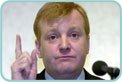 |
| Reputation: Kennedy |
Charles Kennedy has urged MPs to work constructively to salvage the reputation of British politics.
The Liberal Democrat leader on Monday called on politicians from all parties to raise politics from the level of a "playground slanging match" if a repeat of the dismal general election turn out is to be avoided in future.
"By descending into the realms of cheap jokes and personal insults, the reputation of politicians is plummeting. We don't only need to persuade the public that our particular party has the best policies, we need to persuade them that politicians are worth voting for at all, and that politics is worth their attention.
"As the deeds and misdeeds of politicians are reported ever more relentlessly, and in ever more detail, there needs to be a response. Politicians need to work constructively to salvage the reputation of a profession which ought to be important, which ought to be relevant, but which all too often is no more than a playground slanging match," he said.
Kennedy, speaking at a conference on political reputations organised by the Institute of Public Relations, said the personal performance of politicians, as well as their spokesmen and advisors, was now just as important as policies.
"We have seen the repercussions on those who get it wrong, in the case of Jo Moore, author of the infamous DTLR memo calling September 11 a good time to 'bury bad news'. The thought here was bad enough in itself. That it should have been articulated in this way, with the appalling use of the word 'bury', is inexcusable. It revealed flaws which run deeper than any PR 'mistake'," said Kennedy.
The terror attacks in the US, and the "war on terrorism" that has followed it, raised major presentational problems for governments as groups such as al Qaeda were fighting a battle in the media as well.
"The tragedy of September 11 itself was calculated to get the biggest media response possible. There was no doubt that such a dramatic form of terrorism would be broadcast live as soon as cameras could be there. We are living in a world where communications play a much greater part than ever before, and the skill of good PR is invaluable.
"The government is encountering this as it tries to win the battle for public opinion as well as the battle against the al Qaeda network. Having a public which is so well informed, from so many sources through the internet, means that the need to justify the government's position to the public is enormous. Possibly it is greater than ever before," he said.
Kennedy said part of the reason for politicians fall from grace was due to a public that had become increasingly critical and no longer believed in the image of the benevolent politician who knows best.
"For some years now the reputation of politics has not been great, to say the least. The old idea that politicians know best, and are doing their best for the good of the country has gone now, if it ever existed outside nostalgia. This should not be a matter for doom and gloom. This should be a matter for rejoicing," he said."Yes, it is worrying that fewer people are turning out to vote, and fewer people are seeing politics as worth their attention. And those are things we need to address, and that I am personally keen to rectify. But it is only good that people are being more critical, and more vocal in their criticisms. The challenge for politicians is to show people that politics can be a good path for people's criticisms."
The Liberal Democrat leader said the public relations industry would play a key role in the issue of a euro referendum.
"How we sell that campaign will be a challenge. Opinion polls show that whilst people are coming round to the idea of Europe, they still need some convincing," Kennedy said.
The president of the Institute of Public Relations, Ian Wright, used his speech to call for a rigorous new code of conduct for all those involved in political public relations in the wake of the Jo Moore affair.
"It has never been more important for PR professionals to demonstrate that integrity runs right through everything we do. It is high time for every PR professional in Britain - in politics, in business and in the voluntary sector - to sign up to a code of conduct and professional ethics. The code should outline for public relations professionals the responsibilities they owe to their employers, their colleagues and the wider public. It should set standards for behaviour. Most important it would offer clear sanctions for failure to match up to the standards it sets.
Wright, who himself was Paddy Ashdown's press spokesman in the 1997 general election, said it was now vital media advisors were beyond reproach.
"At a stroke we can end many of the lingering controversies which currently plague government 'spin doctors' and financial PR advisers. The code would offer PR practitioners protection from unfair criticism and the public protection from mischievous spinning. Public relations is in the frontline of the battle for reputation, but if we don't act now we will have no reputation to save," he said.
|


