|
Government attacked over stadium confusion
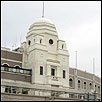 |
| Wembley: Set for demolition |
The government has come under fire after it emerged that its review into the national football stadium will not make a clear recommendation about where it should be located.
The review, led by Patrick Carter, was set up to examine if the project can be funded and managed at Wembley, or whether a location elsewhere in England should be considered.
His report was handed to ministers at the end of August and since then the culture and sports minister, Tessa Jowell, has been considering the implications.
In an apparent change of tune, Downing Street said on Monday that the review was only ever intended to "scope the options" about where the stadium should be located.
Number 10 sources said the Carter report would assist the FA in determining whether to opt for Wembley or Birmingham but would stop short of making an outright recommendation. "It will help the FA in making its decision," a spokesman for the prime minister said.
The Tories have ridiculed the government over the apparent u-turn, suggesting ministers were shying away from taking a difficult decision.
Peter Ainsworth, the shadow culture secretary, said: "Having turned his back on the Dome Tony Blair is now turning his back on Wembley. To state that it is the FA's decision is a downright lie. There is still £120 million of Lottery cash tied up in the proposed Wembley redevelopment - what is to happen to that money?
"If it were true that this is simply an FA project, what right had ministers to make their disastrous intervention two years ago when they decided to tear up the plans for the National Stadium?"
He said ministers were running scared and called for the immediate publication of the report.
"Labour have bungled the entire project since they first took a hand in it. The government should publish the Carter Report without further delay, and announce what precisely they propose to do. However, as usual when things go wrong, instead of finding constructive solutions, the Government's energies seem bent on finding someone else to blame," said Ainsworth.
Troubled project
Attempts to agree a plan for building the national stadium have been dogged by problems. Disagreements over what facilities there should be for sports other than football and rugby, as well as a failure to agree financing for the project, have led to repeated setbacks.
The original £475 million redevelopment scheme was put together by the Football Association's subsidiary, Wembley National Stadium Ltd, but was rejected by then culture secretary Chris Smith in December 1999 after the British Olympic Association complained that a removable running track outlined in the plans would not be up to the job of staging Olympic events.
Smith decided that WNSL should return £20 million of a £120 million National Lottery grant it received from Sport England and athletics was subsequently removed from the scheme.
The FA announced on May 1 2001 that it could not deliver its plans for a national football and rugby league stadium at Wembley without putting its future at risk by committing £125 million in equity, £55 million a year for the debt-term and taking responsibility for any cost overruns.
"The financial model on which the project was based, supported by specialist advice, has proved over time to be flawed," the FA said at the time. It approached the government with a view to securing further public funding, to which the government responded by announcing a wide-ranging review of the project.
Patrick Carter, who examined the finances of the 2002 Commonwealth Games, was appointed as an adviser on the plans by a committee chaired by Jack Straw.
Other committee members are Jowell, transport, local government and the regions minister Stephen Byers, chief secretary to the Treasury Andrew Smith and sports minister Richard Caborn. Its terms of reference are to "consider options and policies for the government's approach towards the redevelopment of Wembley Stadium."
Development of the London site is currently on hold pending a final decision from the government and the FA.
A final decision is not expected for several weeks and consultations with Sport England and the FA are likely to continue.
A survey by the Football Supporters Association indicated that a majority of football fans were in favour of building the stadium in Birmingham, and would prefer it to be a football-only venue.
The survey of 1037 football supporters found that 67 per cent supported building the stadium in Birmingham and 72 per cent were opposed to a running track.
Wembley, Coventry and Birmingham have each submitted bids for the venue and made submissions to the Carter review. Birmingham is thought to be mounting the strongest challenge to re-vamping the Wembley site.
Councillor Andy Howell of Birmingham City Council said the city's delegation had emphasised that it could deliver the national stadium by 2005 at a lower cost than the London alternative.
"We have the site, the expertise, the experience and, we believe, the public and business support to build and manage a top-class stadium the whole country can be proud of," said Howell.
The Birmingham option would see the construction of a £324 million 85,000-seater stadium on a greenfield site near the National Exhibition Centre and the M42.
Arguing that the national stadium should be built in the capital, London mayor Ken Livingstone hit back at the claims that Birmingham was the fan's favourite.
He released details of a rival poll, commissioned by the Wembley Taskforce, which showed 46 per cent of the public backed Wembley, compared to 24 per cent against and 30 per cent expressing no opinion.
"Whilst a very high proportion of the public have not made their minds up those who have made a choice back Wembley by two to one," said Livingstone.
"Apart from understandable regional support near to the Birmingham site, the public is emotionally attached to Wembley through great events such as the 1966 World Cup final and the Live Aid concert," he added.
Livingstone also welcomed endorsements from football stars such as manager of Ipswich Town George Burley and Arsenal and England star Ashley Cole, who said it had been a childhood dream to play at Wembley: "Now my dream could be taken away."
The Commons culture media and sport committee has also examined the affair, and reported in March 2000 that the project had been hit by the "fundamental failure" to include athletics representatives from the beginning in planning the redevelopment.
The MPs were also critical of the roles of Chris Smith and then sports minister Kate Hoey. Both were subsequently sacked by prime minister Tony Blair during his post-election ministerial reshuffle.
|


