|
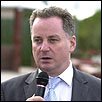
Rt Hon Jack McConnell - first minister of Scotland
Jack McConnell
Question: Are you worried that if the war isn't short and sharp, that there could be a political downside for you?
Jack McConnell: I have two worries about the election: One is that we don't get the turnout that the importance of the parliament would justify.
I've been stressing since Christmas the vital importance of people voting regardless of what way they intend to vote because whoever is first minister after May needs the certainty of a strong mandate when they're conducting discussions inside Scotland or outside Scotland.
And the second concern is obviously about the way in which the news media will be dominated by the situation in the Middle East. Over, at least the immediate period ahead, this might lead to a lack of information about the clear choice that exists for the election being available to voters.
However, I don't see that as an insurmountable problem and the challenge for me and for politicians in Scotland is to be exciting in our campaigning and interesting enough to engage voters right through the whole of April.
Question: Given those twin concerns, is there a case to be argued that we shouldn't go to the polls at a time when we could still be at war?
Jack McConnell: The date of the election has been known for four years and I think it would take quite extreme circumstances for that date to be moved. I think it is possible to have an election campaign where the choice becomes crystal clear for Scottish voters.
So I don't have any difficulty with going ahead with the election on May 1, and if Scottish politicians are interesting enough and ambitious enough in their election campaigning, then I think voters will know where the choice lies come election day.
Question: At this stage though, would you say that you couldn't rule out the fact that there could be some delay?
Jack McConnell: I'm keen that the election goes ahead on 1 May and I don't think there's any problem with that happening.
Question: Looking at more domestic issues, Gordon Brown has expressed concerns about the scope of the private finance initiative - do you share that belief that there are some areas of public service provision in which the private sector's role should be limited?
Jack McConnell: I think we need to make decisions for each public service in relation to both the history, the level of performance and the potential of that service to improve. In Scotland, we need to make our own decisions on this because in almost every part of the public service, structures are different, history can be different, responsibilities and the legal framework can be different, and that's exactly what we have done.
In health and in education, in reform of the courts and the criminal justice system, in transport delivery, and in other areas we have made our own decisions that I think sometimes have been very wrongly characterised as being less reforming and less radical than decisions made in England and Wales. I could give you a series of examples, but I'll give you just two.
In our education service, we have a radical transformation of teaching contracts and responsibilities in Scotland taking place at the moment which I think is going to deliver higher standards in Scottish schools and a better teaching workforce in the years to come. That is very distinctively Scottish.
But also in relation to the public private partnerships, the private finance initiative, is being used much more extensively in Scotland than south of the border, and I think we are seeing the benefits of that in schools, health facilities and other improvements in public infrastructure.
Question: Why do you think the unions are still not persuaded of the need for PFI?
Jack McConnell: I think the unions have a duty to represent their members, and unions traditionally have reservations about changes in working practices and the introduction of efficiencies. But I think our interest has to be in the public purse, best value for money and a best delivery of contracts.
Consistently in Scotland, with new hospitals, new schools and other improvements in public services, public private partnerships have delivered, on time and in budget, the infrastructure that Scotland needs within a best value framework.
Question: Looking beyond the election, and if you secured an overall majority, what would be your three main policy priorities?
Jack McConnell: Well, I think we've made great strides in Scotland over the last four or five years in education.
We have taken a system that was overloaded, lacking direction or leadership and less ambitious about raising standards than it should have been, and we've turned that now into an education service that is really going somewhere and is going to deliver for Scottish schoolchildren over the next decade.
I think what we now need to do is achieve that same clarity of leadership, direction and improved standards in health, in tackling crime, and in the delivery of transport projects. I think those are therefore the three key areas where most work will be concentrated in the early years of the new parliament.
Question: On issues such as NHS waiting times and the prisoner population there is a sense that you are still to deliver on your priorities from the last election, isn't there?
Jack McConnell: In each of these areas we've tackled the challenges step by step. If you take health, for example, there have been radical reductions in the waiting times for Scotland's key killer diseases and there is such significant progress on waiting times overall that in February we were able to say that for an inpatient appointment, Scots who are a clinical priority no longer have to wait more than nine months.
But we've not made the progress we wanted to make on outpatient appointments. I think we started too late to tackle that issue and we now have a clear strategy that is going to take us through the next parliament to a situation where Scots don't have to wait too long for their first appointment with a consultant.
Step by step we are tackling the challenges that we set ourselves and were set by the public, more importantly, and I hope that we are learning all the time from the successes as well as the failures.
Question: You've said recently that Holyrood in one sense hasn't lived up to expectations - what specifically did you mean by that?
Jack McConnell: There was great excitement in 1999, and not just those of us who had been fortunate enough to be elected, but widespread throughout the country.
I think for a variety of reasons, partly the spiralling cost of and the controversy around the new building, which is not yet finished, partly the way in which we conduct debates in our parliamentary activities in the chamber, partly because of the occasional distraction into issues that were not seen by people to be part of those core priorities of education, health, transport, crime and jobs, the parliament has, at some points in the last four years, disappointed.
But there is a fresh focus and direction, there is now a clear strategy, particularly over these next three years, as public spending increases, now a programme of reform to deliver from those increases, and I believe that the second term in the parliament can be a massive opportunity, a very exciting time for Scotland.
We need to seize that opportunity and certainly not go down a road which would lead to more upheaval and uncertainty, and that is independence for Scotland.
Question: You mentioned the new parliament building, and a sense that the parliament hasn't delivered - doesn't that go back to the days of Donald Dewar. This is a Labour problem rather than a parliament problem, is it not?
Jack McConnell: When we were elected in 1999, the parliamentary authorities took responsibility for the building and all of the associated work in relation to that. I think that was a right decision at the time, but it did mean that the responsibility for the cost of the building, the preparation of the building, was shared amongst all of the political parties and all of the MSPs.
And I think that those who seek to abdicate any responsibility for that are doing exactly the sort of thing that reduces the credibility of politicians and confidence in politicians. Scotland and the UK as a whole would be far better places - and we would have far more confidence from the public as politicians - if more politicians accepted their responsibility for the decisions that have been made, but also for ensuring that they never happen again.
Question: Tommy Shepherd's recent remarks suggest the fact that rank and file members don't believe you're fighting their corner?
Jack McConnell: I don't see any evidence of that at all. But I'm not first minister for Labour Party members, I'm first minister for Scots, and my objective in running an efficient but effective reforming devolved government in Scotland is to make sure that Scotland becomes a better place.
There will be people who will be disappointed with particular decisions along the way, but I think that the programme of investment and reform that we are now engaged in has the potential to radically transform Scotland over the next decade and I hope that we will get the opportunity to do that when voters face a clear choice between two futures come May 1.
Question: What do you think Scottish voters could expect if they woke up to a parliament won by the SNP?
Jack McConnell: I suspect all those people who didn't vote and many of those people who had voted Scottish Nationalist would immediately regret their actions the previous day. The Scottish Nationalist Party are trying desperately to hide from the public their main policy, which is of course independence for Scotland, a divorce from the rest of the United Kingdom.
They're trying desperately to hide that because not only do they know that it's currently unpopular but also that it would be absolutely disastrous for Scotland at a time when our economy is pulling out of a difficult period, and at a time when we have just bedded in devolution, learnt from some mistakes and are making some progress.
At a time of great insecurity in Britain and the world, the last thing that Scotland needs to do is divorce itself from the rest of the UK.
The Scottish Nationalist Party actually know that, although they can't change their ideology, and they're trying desperately to hide that. And my job over the next month is to make sure they can't hide. They stopped talking about independence, but I'm going to talk about independence, and I'm going to do it all over Scotland.
Question: Considering you work so closely with the Lib Dems, what would be wrong with a Lib Dem government?
Jack McConnell: I think the partnership government in Scotland has been good for the country, it's been good for devolution for the early years, it's provided stability and it has ensured that the policies of both parties have been challenged rather than simply allowed to pass through the parliament by a majority.
I hope we've all learned from that process, we go into this election campaign fighting as separate parties, we will put forward our programmes, and I'm sure we're both campaigning to try and secure a majority.
Question: Given the past failure of Labour as a one party state in local government, would it not be better for the party to continue in coalition, rather than increase its dominance?
Jack McConnell: First of all I think that criticism is actually not based on fact, because a minority of Scotland's councils these days have straightforward Labour majorities and some of the councils feel there have been serious problems in recent years having councils with either coalition arrangements or other parties in the majority.
I think what's important is that we are able to make the right decisions for Scotland. My campaign in these elections is going to be to say that the priorities that I passionately believe in and that the Labour Party stands for - which are of driving up standards in education, of improving our national health, of ensuring that we have a growing economy that is dynamic and enterprising and that we have communities where we're tackling crime and we're creating a strength in the community that allows people to live together in peace - are the priorities of Scotland and they will be the priorities that will be better implemented the more Labour MSPs there are.
Question: This is the first time you've gone to the country as first minister, how would you characterise yourself personally in that role?
Jack McConnell: I cast my first vote in the 1979 devolution referendum, I was deeply disappointed then that Scotland didn't get a devolved assembly. I spent 20 years of my adult life campaigning for a Scottish parliament, and I was as proud as punch to be part of that parliament in May 1999.
I think that I watched and learned from the early years of the parliament what was required and I believe as first minister that I have been able to provide direction, not just stability, but direction and a radical vision for Scotland that will see our country transformed into a nation in far better shape than we are today.
I hope that I'm going to have the opportunity to spend not just 18 months achieving that vision but another four years as well.
|