|
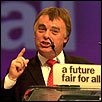
Andrew Smith, Chief Secretary to the Treasury
Andrew Smith
Question: On the one side you have the Lib Dems who propose increases in tax to pay for key public services, and the Conservatives on the other side openly advocate £8 billion in tax cuts. New Labour is being squeezed in the middle of this tax and spend debate isn't it?
Andrew Smith: Not at all. On the foundation of the stability that we've put in place in the economy we favour a balanced approach: increased investment in health, education, transport and fighting crime with, as we have done already, affordable tax cuts on our priorities.
Question: So a 'balanced approach' means no radical solutions. Sober stability is the best way forward.
Andrew Smith: I think carrying forward the biggest hospital building programme the country's ever seen; raising literacy and numeracy standards in our schools; the first government to go into an election with a lower crime rate than we inherited when we came into office. I think that's very radical indeed. But it's based on stability. At the end of the day the sure foundation for investment in our public services is sound public finances.
Question: Let's take the Lib Dems' criticism of you first. They say you've talked up your commitment to public services but when it comes down to the figures public spending has increased by just 1.3 per cent a year between 1997 and 2001. Lower than the growth seen under the Conservatives during their eighteen years in office. Why?
Andrew Smith: We increased significantly from 5.7 per cent to 6.2 per cent the share of GDP going into health and we've increased something like 4.7 per cent to 5 per cent the proportion of GDP going into education. And in our spending review we've shown how we would double a net investment over the next three years. So we are putting huge extra resources into health, education, fighting crime and transport.
As you will have seen from our pledge card, we are committed to ensuring there are 20,000 extra nurses, 10,000 extra doctors, 10,000 extra teachers, 6,000 extra police. We are able to make those commitments and to deliver those commitments because we have built a strong economy. We will do nothing to put that stability at risk. And I have to say that the Liberal Democrats' sums simply don't add up and, like the Tories, they cannot be trusted on the economy.
Question: Looking back, were you too cautious on public spending in your first two years in office?
Andrew Smith: Not at all. It's because we took tough choices and applied fiscal discipline that we are now able to make the necessary investments in health, education, transport and fighting crime that we're making.
Question: The Lib Dems say you're timid on tax: you're terrified of admitting to middle England that to pay for increased public services taxes will have to go up.
Andrew Smith: We, as I've said, we are following a balanced approach. Based on the platform of stability we've put in place we're making investment in the public services people want to see, and combining that with affordable, targeted tax cuts.
Question: The Institute for Fiscal Studies say that if you were to extend your current spending programme beyond 2003 to 2004, then you need to find an extra £5 billion a year. What's your response to that?
Andrew Smith: Our plans are set out in the budget documentation and are sustainable on prudent and cautious assumptions.
Question: What would you do then in 2004 and 2005?
Andrew Smith: As I said, the plans are set out in the budget documentation and are sustainable on prudent and cautious assumptions.
Question: But would you increase borrowing to pay for it?
Andrew Smith: All the projections, not only on prudent and cautious assumptions, but actually also on an even more cautious assumption that trend growth turned out to be 1 per cent lower than is forecast, still we maintain our commitments and we also meet our key fiscal rules. And everything we do will comply with those fiscal rules - that is we balance the current budget over the economic cycle and we keep debt to prudent and sustainable levels.
Question: So taxes could go up? It would be fair to say they could go up?
Andrew Smith: I've already said we have a balanced approach on this based on a platform of economic stability combining investment with affordable and targeted tax cuts. And this is all set out in the budget documentation. It is all based on prudent and cautious assumptions.
We kept every promise that we made on tax at the last general election. We said we wouldn't put up the basic or higher rate and indeed we cut the basic rate. We said we'd bring a 10p starting rate when it was prudent to do so and we did. We said we'd cut VAT on fuel to its lowest possible level and we did. And we've also brought in the lowest tax rates on large and small businesses of any of our major competitors. So we keep our promises on tax.
Question: But the overall tax burden did increase.
Andrew Smith: The overall tax take as a share of GDP is actually lower this year than the Conservatives were forecasting when they left office.
Question: The Conservatives accuse you of stealth taxes. Do you think the public prefer indirect taxes to direct taxes?
Andrew Smith: With the stability we've put in place, we're balancing, as I've said, much needed public investment with targeted tax cuts where these are affordable. I've been through all the promises that we kept and those were promises on indirect taxation as well as promises on direct taxation. I believe that the public see why the balanced approach we favour makes sense.
Question: Do you believe indirect taxes are fairer than income tax?
Andrew Smith: As I've said, it's a balanced approach that we're following, and I think that's something which the public understand. They understand very well too that for the Tories to have banged VAT on fuel was very unfair. It would have been at twice the rate if we hadn't stopped the Tories increasing it. And we have cut it to its lowest possible level. And also of course the Tories put on the automatic escalator on fuel duty and it's Labour which has taken it off. And we also provided the targeted cuts in ultra low sulphur petrol and indeed as part of our reform of vehicle excise duty, help for the drivers of less polluting cars by the way of very substantial vehicle excise duty reductions.
I think you can see how we are indeed following that balanced approach in indirect as well as direct taxation.
Question: You claim you are the party of business. Will you rule out further tax increases for business?
Andrew Smith: Well as I've said, we've brought in the lowest rates of corporation tax; we've cut the rate of tax by 3p both for large and small businesses. The proof of our policies are that there are now 150,000 more businesses operating in our economy than there were in 1997.
As far as the future's concerned, Gordon Brown has said that the 10p rate we brought in for small business, that we will be looking to extend that 10p rate when prudent to do so.
Question: Businesses are concerned over red tape and work life balance regulations. What would you be doing to reassure businesses in these areas?
Andrew Smith: First of all, every action we take in these areas is after extensive consultation with business. We believe that partnership in the workplace, right to maternity leave, the measures also which help make work pay - the working families' tax credit, the New Deals - these measures are helping businesses by helping them to recruit and retain workers, especially in tight labour markets.
Question: Finally you say you want to foster an enterprise culture. How do you foster an enterprise culture?
Andrew Smith: First of all with the policies for economic stability which now see the highest employment ever with a million more people in jobs - that's a very tangible way of fostering a work and enterprise culture.
Question: Does it require a change in attitude from the public?
Andrew Smith: I think that attitude change has been underway since Labour's been in government with our Welfare to Work and New Deal programmes. We are building a culture of the work ethic which mass unemployment and neglect was destroying under the Tories. And we see from the 58 business leaders endorsing Labour's approach this week, this is something which is appreciated by business as well as all those people we've helped off benefits and into work.
Question: What will you be doing to further strengthen a work ethic?
Andrew Smith: We will be building on the measures we've already taken - measures like the Enterprise Management Incentive; the New Deal self-employment option; the New Deal programmes themselves which give people help to get into jobs but make it clear that those rights are matched by responsibilities. Other measures we're taking like the increase in Venture Capital funds, Enterprise Scholarships to help young people from disadvantaged areas get management and business education. We really are driving for investment and more business growth and ensuring that entrepreneurship can be an engine of regeneration in our most disadvantaged areas as else where. And I will just remind you that the recent Arthur Andersen survey said that the UK was the most entrepreneur-friendly environment in which to start up new businesses.
|