|
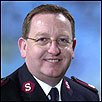
Bill Cochrane - secretary for communications of The Salvation Army
Bill Cochrane
Question: The Salvation Army is publishing a report on the social and economic circumstances in life in Britain. What is the background to the report?
Bill Cochrane:The Henley Centre has produced two works for us in the past few years. One was the Paradox of Prosperity in 1999 and then two years later, The Burden of Youth, which both looked at trends in particular areas.
They have been extremely influential for us determining our policies for the future and we needed to move on with that, so we asked them to do this piece of work, looking particularly at the needs of people who might be described as the time-consuming, the unfashionable and the unrewarding.
In other words the people who continually seem to fall into the gap of caring.
What they came up with was this report which we've called The Responsibility Gap: Individualism, Community and Responsibility in Britain today.
Question: What were the main conclusions?
Bill Cochrane: The report tells us that 21 per cent of the population don't want to care for an elderly relative. And 34 per cent are concerned that there isn't going to be anyone to look after them when they need it, which is very worrying. The report also tells us that there is a rise in individualism in Britain, with the trend more about a sense of self-reliance and personal responsibility impacting on our willingness to accept responsibility for other people.
There is still a sense of community, it's not dead, but it's being manifested in different ways. There is a shift from communities of geography to communities of interest, communities of necessity to communities of choice and permanent communities to impermanent ones.
So obviously these are affecting and helping to contribute to what we consider to be shortfalls in the provision of care for people in need.
Question: So what needs to be done?
Bill Cochrane: This report sends different messages to different people and I think its clear that we need to do something to close this gap in terms of people in need.
It's not just about saying that more money needs to be spent on services. It's really about the way we evolve as a society and how well we can respond.
But the report clearly identifies the four pillars of care in society: individuals, government, charities and the private sector. What we're seeing from the report is that the partnership between those four pillars is not being developed adequately and we want to challenge people to do something about it.
So there is obviously a word to the government and the private sector. After all, 80 per cent of people are saying that companies have a responsibility to help support the society in which they operate.
There is also a huge challenge to charities. 79 per cent of people are saying that charities have to fund many of the basic social services that should be provided by the government.
However, the report certainly does not simply attack the government or other agencies for failing. Indeed, it actually points out that 37 pent of people say that the government is having to fund many of the basic social services that should be or could be provided by the family.
Question: The Salvation Army is one of the largest, most diverse providers of social welfare in the world. Have you found that under this government the demand for your work has increased or diminished?
Bill Cochrane: We were formed in Victorian Britain where the challenge particularly was dealing with poverty and extreme deprivation. The vision of the founders was that this was going to be a short-term thing, and particularly since the advent of the welfare state, one would have hoped that there would not be the need for charitable help on the scale we are now experiencing.
A lot of the increased demand for our services is because the government trusts the voluntary sector to provide a high level of professional support to people in need and makes a substantial contribution to the sector to do that.
The Responsibility Gap report however shows that there continues to be a gulf between the resources that are being put on the table and the needs that are still out there to be met.
But these needs are always changing. This is because society has altered and the traditional means of care for vulnerable people such as the elderly have diminished.
More women for example are able to go to work and now both partners in many families have to go to work to keep a roof over their heads. This means that children have lost that traditional means of support so someone has to pick that up somewhere. We think there is a role for both the voluntary sector and the government, as well as people in neighbourhoods to pick up this challenge.
So there is certainly no diminishing in the demand for what the Salvation Army provides - it just increases, almost on a daily basis.
Question: Do you have enough volunteers to do your work?
Bill Cochrane: Certainly in terms of people who are willing to give their time, we, and most organisations, rely on people who are older because they have more time.
There is a growing number of those which is great, and many older and mature people with all the experience of life make a fantastic contribution to what we have to do. But for younger and more active and more able people they inevitably are busy and have busy lives.
The report showed how people feel about volunteering and that's where we think that the contribution of companies, through corporate social responsibility initiatives, is very significant. In other words we would like to encourage companies to be imaginative in the ways they interact with charities, such as giving their employees time to engage in social volunteerism.
But The Responsibility Gap is telling us that a lot of people see volunteering as a positive thing - something they can add to their CV and get something back from as well. There's nothing wrong with that. The Salvation Army has committed itself to looking at how it attracts and enthuses volunteers and will be drawing up a national list of volunteering opportunities with different things to suit different people.
Question: What do you think of the government's plans to extend licensing hours and relax gambling rules?
Bill Cochrane: Well it's quite simple really, the more opportunities there are to drink and gamble, the more people are going to do it. Adults can choose for themselves whether they drink or gamble but public policy should recognise that both activities can cause a minority of people real problems.
We have made strong submissions on both those issues - substantial contributions to the debate on licensing and gambling.
We were pleased that ministers accepted some of the issues that we were pressing concerning licensing. For example, we managed to secure change that protected children.
For the first time now it will not be acceptable for children to enter places where the primary purpose is the consumption of alcohol on their own and we managed to get that amendment into the Licensing Act.
But we have major concerns about the gambling proposals - which we think are shared by the British public. In an NOP poll commissioned by The Salvation Army 93 per cent of the public said that there were enough opportunities to gamble in the UK at the moment. So we think on the issue of extensive gambling deregulation the government is really out of step with the public. After all, up to 400,000 people have problems with gambling addiction and the bill as it stands gives a lack of protection to young people and children.
Even after this Bill, we would be the only country in the developed world where children would be allowed to participate directly in gambling even though in our poll 82 per cent of the population said that children should not be allowed to play fruit machines.
|