|
Forum Brief: Top-up fees
The government has narrowly seen off a rebellion on top-up fees following a day of high drama around the Palace of Westminster.
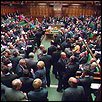
Following weeks of arm-twisting - coupled with a series of concessions - ministers saw the Higher Education Bill pass at second reading with a majority of just five.
Tim Yeo, shadow education secretary, said: "A government with a normal majority of 161 has got this Bill through with the smallest majority this government has ever had. As one Labour MP said: 'to create a cliffhanger like this with a majority of 161 demands absolute incompetence.
"This is the government's flagship Bill of this Parliament. This is a prime minister who nailed all his authority to this Bill. And the result has been one of the biggest rebellions of Labour MPs against the Bill, against the government, but most telling of all against the prime minister himself.
"It is one of the biggest rebellion of Labour back bench MPs - ever. This vote is not a win. It is a personal humiliation for the prime minister."
Charles Kennedy, Liberal Democrat leader, said: "Nobody has emerged from this shabby compromise with any credit. It took a dodgy deal between the prime minister, the chancellor and backbenchers to get this Bill through.
"It's a poor reflection of the government of the day and will be very damaging for the prime minister.
"This may prove to be a hollow victory for the government. It's certainly not a victory for future students, particularly those from poorer backgrounds, who will face massive debts. And it's not a victory for universities, who will still be under funded.
"The Liberal Democrats will maintain our campaign for the principle of funding higher education out of fairer taxation."
Forum Response: Association of Teachers and Lecturers
Dr Mary Bousted, general secretary of ATL, said: "The government should never have allowed itself to get into the position where a vote on the crucial issue of student funding became a vote of confidence in the prime minister.
"Some of the hard won concessions go some way to meet the concerns of our members but the bottom line remains that fear of debt will deter too many of talented young people from entering higher education.
"Student teachers are likely to be particularly disadvantaged. Their starting salaries will be just enough to start paying back their debts but most will never earn the kind of salaries that Tony Blair has promise graduates.
"The greatest impact will be felt by undergraduate student teachers, who are not eligible for the bursaries available to their PGCE counterparts. This is likely to decimate the undergraduate teaching courses.
"This will futher damage recruitment into teaching because these courses play a vital part in widening access into the profession, particularly for mature entrants, returners, students from ethnic minorities and those using access courses.
"The Bill is not acceptable to anyone. It doesn't solve the university funding problem, it does not help students and it does not sufficiently help poorer families. It will not anser for now or for the future."
Forum Response: Universities UK
Professor Ivor Crewe, president of Universities UK, said: "This is a landmark Bill which represents a critical point for the future of higher education. Looking ahead, Universities UK will continue to represent the interests of the University sector in the details of the Bill which will be discussed at committee stage."
Forum Response: National Union of Teachers
Doug McAvoy, general secretary of the NUT, said: "The government's plan illustrates its political philosophy rather than a desire to ensure our universities are adequately funded. The prime minister has acknowledged that the money raised will not be sufficient to ensure stable and adequate funding for the future.
"The plan to freeze fee levels for a period means that the existing inadequacy in funding will become worse.
"One danger the NUT perceives from this bill is the extension of a market place philosophy elsewhere. Currently we see it in the home secretary, David Blunkett's approach to policing where he is proposing to encourage communities to fund for themselves additional security.
"This leads me to fear that parents will be asked to fund for themselves better class sizes for their children and to fund for themselves the employment of qualified teachers rather than the use of unqualified person to teach their children.
"Once the principle of variable payment for more or better provision of education is established, rather than funding through direct taxation, then it is right for us to fear the extension of that principle to elsewhere in the education service."
Forum Response: Universities Council for the Education of Teachers
A spokeswoman for UCET told ePolitix.com: ""As Nick Brown said, 'the devil is in the detail'. UCET awaits the details, to see what effect they will have on teacher education students."
|